The Green, Green Vegetables of Home

Click any image to open a slide show

I’ve mentioned before that we don’t live in a town, city or even a small village.  We live in the open countryside (known locally as el campo), so our garden isn’t the kind of cultivated area we used to have back in England.   Our house was built onto a hill-side of almond trees and indeed, when we moved here almost eight years ago, the only things that were already planted (apart from the naturally-placed wildflowers) were 47 established almond trees, on almost an acre of land.   Of course, the area immediately around the house, car park, swimming pool and terraces is flat but the rest of our land is sloped, and we have chosen to leave a more “natural” look  further away from the house, to blend in with the surrounding countryside.

As time as gone by we have added many more trees, shrubs and bushes and I have previously posted photographs of lemons, apple blossom, bird of paradise flowers, figs, oranges and some of the many beautiful wildflowers at present gracing the garden.

Despite the apparent poor quality of the soil, the valley where we live is extremely green with trees and vines growing down the hillside.  Newly planted trees need care for the first year or two, but once established seem to thrive, provided they are given sufficient irrigation.  

The nature of the ground is generally sloping, rough and rocky with poor, shallow soil over bedrock.  Untended ground is usually very hard (with need for a pick-axe to dig holes for planting) allowing deluges of rain little chance to penetrate the soil, thereby creating deep channels where the water has run off .

However, it’s not all bad news as there are patches of slightly deeper soil here and there, and it’s one of these that last week we decided to transform into a small vegetable patch.

We were able to buy some little plug plants in Vélez-Málaga, at a total cost of just over 11 euros and, after quite a bit of digging, raking and throwing out stones, we finally got to plant red, green and hot peppers, chard, squash, green beans, red and green lettuce, red onions, fennel and melons.

After three days, I can report that the little plants appear to be doing well.  I’ll keep you posted on their progress!
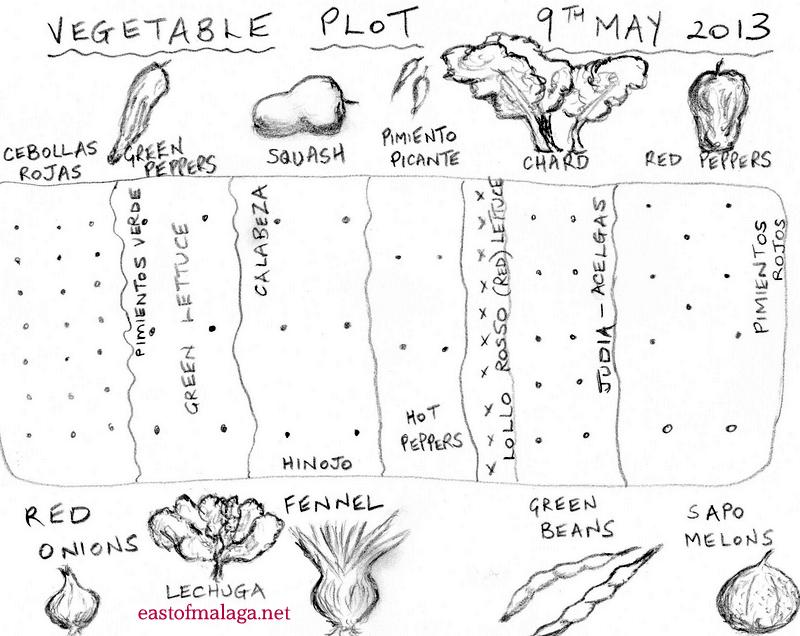
Vegetable plot - planting plan

Previous posts you might find interesting:

A Slice of Life: Garden and Plant Irrigation

Flowering snapshot of a January day around the garden

Wildflowers of Andalucía: Dutchman’s Pipe

English Language Publications for FREE!

Whilst you are visiting any town or village throughout the Axarquía region, a selection of English language newspapers and magazines is available for you to collect, free of charge.

These publications, including Spanish Insight, SolTalk, Streetwise, Marketplace, Grapevine, Sentinella and Euro Weekly are useful for both tourists and residents alike.  Each contains information about ‘what’s on’ in the local area as well as some well-written articles on a wide range of topics, recipes and items for sale – including properties.  (You can CLICK on the links to be taken to the online versions of the publications).

Sadly, in order to make-ends-meet with their budgets, these magazines contain more advertisements and fewer articles as time goes by, but I guess that happens round the world.

You will find these free magazines in many estate agents, bars, cafes and other such popular places.

How do you like to discover what’s happening in your local area?

You might also like to have a look at:

Spanish football: Estadio La Roselada, home of Málaga CF

Flowering snapshot of a January day around the garden

The Buddhist Stupa of the Eastern Costa del Sol

Travel Theme: Multiples

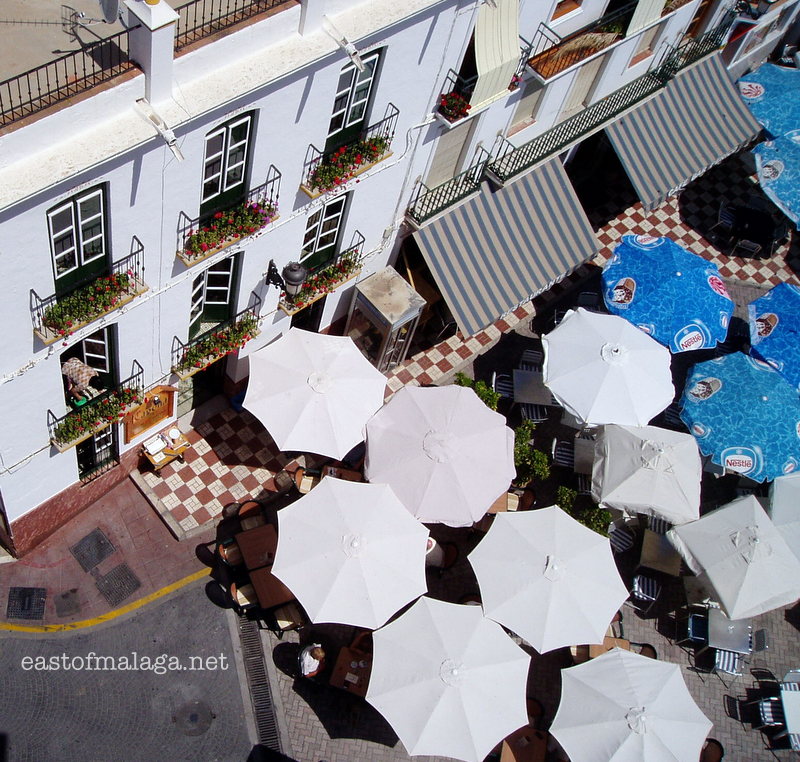
Looking down from Còmpeta church tower


Looking down from the tower of Còmpeta’s church at the many umbrellas shading customers at the bars and restaurants in Plaza Almijara.

This is my response to Travel Theme: Multiples


More photo challenges you might enjoy:

CBBH Photo Challenge: REFLECTION

Sunday Post: GOALS

Weekly Image of Life: WISHES FOR 2013


CBBH Photo Challenge: BLUE

This month´s CBBH Photo Challenge is leaving me feeling anything but BLUE – because I just love the colour!

According to this website: “Color is a meaningful constant for sighted people and it’s a powerful psychological tool.  By using color psychology, you can send a positive or negative message, encourage sales, calm a crowd, or make an athlete pump iron harder.

Psychology of Color: Blue

Ask people their favorite color and a clear majority will say blue. Much of the world is blue (skies, seas). Seeing the color blue actually causes the body to produce chemicals that are calming; but that isn’t true of all shades of blue. Some shades (or too much blue) can send a cold and uncaring message. Many bedrooms are blue because it’s a calm, restful color. Over the ages blue has become associated with steadfastness, dependability, wisdom and loyalty (note how many uniforms are blue). People tend to be more productive in a blue room because they are calm and focused on the task at hand. Some studies are showing that weight lifters can lift more weight in a blue gym – in fact, nearly all sports are enhanced in blue surroundings.”

windmills of la mancha, Spain

The best examples of restored “Don Quixote”  Spanish windmills can be found in Consuegra, not far from Toledo in central Spain, where several mills spike the hill just outside of town.  I certainly had some tilting to do, to capture not only the sails, but also the magnificent blue of the wide open sky.

BLUE PAINTED DOOR IN THE HAMLET OF ACEBUCHAL, ANDALUCIA

This blue painted door can be found in The Lost Village of Acebuchal,  situated in the heart of the Sierras de Tejeda, Almijara and Almara Natural Park.   The village, which sits on the traditional muleteers’ route between Granada and Malaga was abandoned and in ruins from 1949 to 1998, but has now been beautifully renovated, restoring the original style.

plumbago in low light

When I bought my new Canon Powershot SX220HS camera back in June,  I was playing around with the low-light setting, and managed to capture the beautiful blue plumbago plant growing in my garden.  It´s such a pretty colour.

Lady in blue - Colmenar, Spain

A few weeks ago, I travelled to the village of  Colmenar to meet up with another local blogger.  Whilst I was waiting in the square opposite the Town Hall (Ayuntamiento) at the appointed time, I couldn´t help but notice this couple sitting on a nearby bench, deep in discussion.  My eye was drawn to the colour of the woman´s clothing, which was the most amazing shade of blue. 

Street sign for Calle Beso, Torrox, Spain

This street-sign in the nearby white village of Torrox always makes me smile.  Beso in Spanish means “kiss” – so this is Kiss Street!

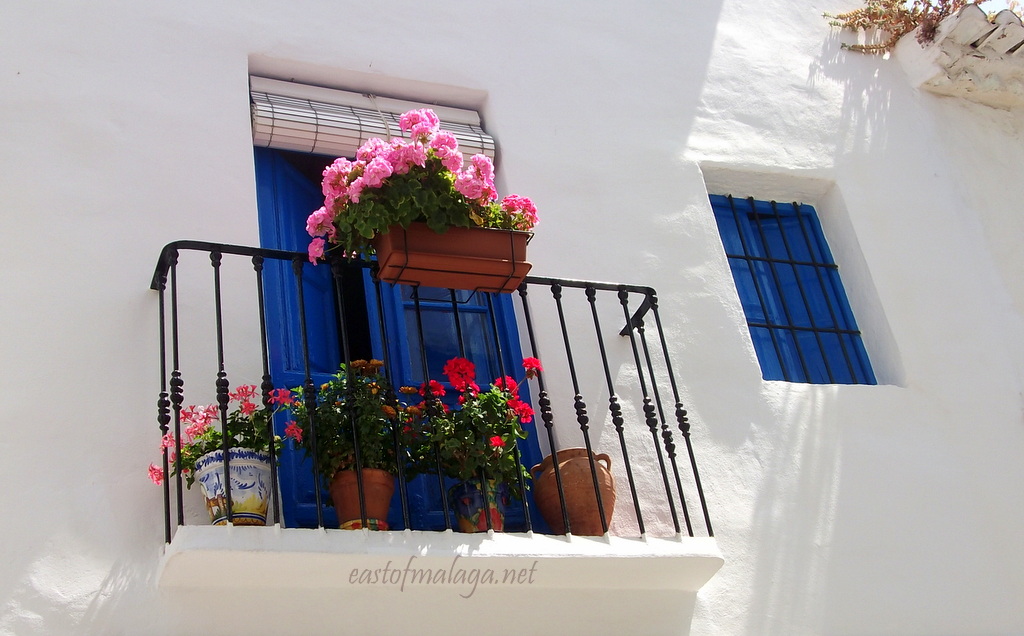
Balcony blue - Cómpeta, Spain

My final image for this month´s Photo Challenge is from my home village of Cómpeta, and shows a pretty balcony, filled with flowers, against the  deep blue painted windows as their background.

This month´s CBBH Featured Blogs:

** Alyson at the Algarve Blog is a very talented artist and, along with her hubby Dave (a peanut-butter-loving photographer), give regular glimpses into their expat life in southern Portugal.

I am particularly enjoying reading Aly´s A – Z of Portugal, where she takes each letter of the alphabet and writes a different post using the letter as the basis for a post, about things she cares for in Portugal.   This is a very easy blog to read, with many stunning photographs, which always makes me glad that Portugal is an easy drive from my home in southern Spain.

** Talking of a friendly blog with great photos leads me on to my next choice – the Lucid Gypsy.   Gilly describes herself as “a middle aged techno hen with a passion for travel, writing, reading and well, life” – and is very busy working full time, studying and crafting pretty things in the beautiful south west of England.

Gilly loves taking part in Word and Photo Challenges and is always quick to leave an encouraging comment.  Why not pop over and say HELLO to her?

So that´s the CBBH Photo Challenge for November, folks!

Remember, all you have to do is post your entry by the end of the monthlink back to this blog and, most importantly,  don´t forget to add links to any two blogs that you´ve commented on during the past month, so that we can all HOP OVER and have a look.  Make sure you FOLLOW THIS BLOG so you don´t miss next month´s exciting challenge!

For more information on how the CBBH Photo Challenge works click here.

I hope everyone taking part enjoys the exposure the CBBH Photo Challenge offers to featured blogs and, who knows, you may end up finding a new favourite!  I´m looking forward to seeing your interpretations.

[CBBH logo Image credit: (cc) Mostly Dans]

The Day of the Dead: A Celebration of Life

Entrance to the cemetery at Comares, Spain

Customs and celebrations to honour the end of the harvest, the change of the seasons and the passage of life into death come together in many notable traditions at this time of the year.

The festival of Todos los Santos (All Saints´ day)  is celebrated throughout Spain as a national holiday on November 1st each year.

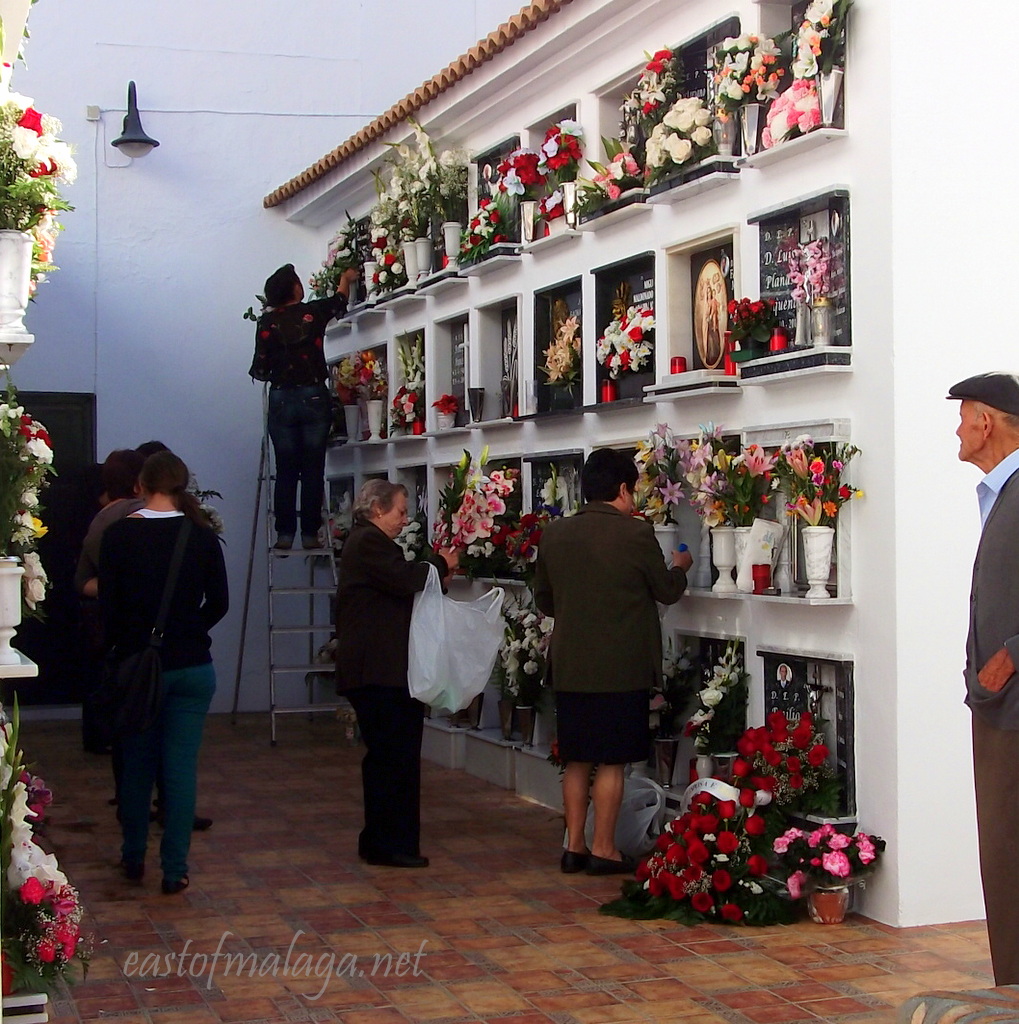
Tending the graves in Competa cemetery for Todos Los Santos

Although the American-style “ghosts and ghouls” type of Halloween is now creeping into the Spanish calendar each year (sadly), traditionally this time is celebrated here in a different form, as “El Día de los Muertos” or the “Day of the Dead” .

The three-day event, beginning on the evening of October 31 and ending on November 2 (All Souls´ day) sees cemeteries packed with families paying homage to their dead.   Family members tend the gravestones of their loved ones by painting, weeding and cleaning them, and by placing fresh flowers and candles.

Cleaning the gravestones in Competa cemetery, Spain

Climbing up the steps to tend the grave in Competa, Spain

We often visit our local cemetery on November 1st, and apart from the sheer number of people, the first thing that always strikes me is the overwhelming fragrance of fresh flowers.

Family members of all ages arrive carrying vases, buckets, bottles of water, cleaning items, candles and arms full of flowers.   The atmosphere is not at all solemn and the sound of chatter is everywhere, with people greeting each other with kisses and hugs.  Each member of the family plays their part in the cleaning and tending of the grave and, when they were finally satisfied, they wandered around the cemetery, looking at other graves to remember the dead,  before leaving.

Fresh flowers on all the newly-tended graves in Competa, Spain

Cómpeta cemetery, Spain

What I particularly like about this lovely Spanish tradition is that all of the frightening aspects of the afterlife are taken out of it.  This is a commemoration for loved ones with nothing ghoulish or scary involved.   Exactly as it should be, in my opinion.

How do you honour loved ones who have passed away, in your part of the world?  

Here are some other posts that I hope you might enjoy:

The heart of Cómpeta: El Paseo de las Tradiciones

The Buddhist Stupa of the Eastern Costa del Sol