Venturing further afield: A long weekend in Zaragoza

We love to travel not only locally, but throughout Spain, so I will also include information, from time to time, about where we have visited.  Usually these places can either be driven to within a few hours of our home, east of Málaga, or we will have flown there from Málaga (AGP) airport.

Zaragoza and the River Ebro, Spain

We managed to find some cheap return flights from Málaga with Ryanair  to Zaragoza in northern Spain.  If you take only hand luggage, there are often bargains to be had,  so if you have a few days to spare, it is well worth spending a long weekend in this beautiful city.

Situated in the northeast of the country on the river Ebro, Zaragoza was once an important Roman colony, a thriving Muslim city and a cornerstone of the Catholic Spanish empire.   This ancient city has the fortune of being located between Madrid, BarcelonaValencia and Bilbao, which probably accounted for it’s prominence.

Zaragoza is Spain’s fifth largest city and is the capital of the immense autonomous region of Aragon.

Roman walls in Zaragoza, Spain

Deriving its name from the Roman Emperor Caesar Augustus,  Zaragoza has a real Roman theme to it, with an 80 metre section of  the old city walls still surviving, as well as a forum, theatre and baths.

We lost no time in getting to know this charming city which, despite having a population of over 700,000,  feels surpringly small and easy to get around.

Zaragoza cathedral

We visited the beautiful Baroque Catedral-Basílica de Nuestra Señora del Pilar and took the scenic elevator inside the highest tower for magnificent views over the River Ebro and the city.

Palacio de la Aljafería, Zaragoza

We were amazed by the Palacio de la Aljafería  which pre-dates the Moorish Alhambra Palace in Granada, and is the home of the regional parliament of Aragon.  The Mudéjar Architecture of Aragon, including the Basilica, La Seo Cathedral and the  Aljafería Palace have been designated a UNESCO World Heritage Site.

Zaragoza is a city that may not figure on the typical tourist trail around Spain but, nevertheless, may just be one of its best kept secrets! 


You might also enjoy:

A weekend away: Santiago de Compostela

Venturing further afield: San Sebastián in the heart of Basque country

A long weekend in Santander


CBBH Photo Challenge: PINK

Did you enter the “Capture the Colour” photoblogging contest last year?  I did – along with thousands of others, and you can see my entry here.  The idea was simple –  publish a blog post showcasing five of your favourite travel photographs which best capture the colour of the five categories: red, blue, green, yellow and white.  

The Capture the Colour Contest proved so popular that it’s back again for 2013 and this is my invitation to each of you to search through your photo libraries and see what you can come up with.

To get you in the mood, whilst you are searching for your multi-coloured photographs, I thought you might like to pluck out one or two PINK photographs for this month’s CBBH Photo Challenge. 

Don’t forget that the CBBH Photo Challenge is a little different from some other challenges, in two ways.  First, it’s only once a month – giving you lots of time to consider your entry before the end of the calendar month.  Secondand most important, this is a BLOG HOP (after all, it is the CBBH – Conejo Blanco Blog Hopmeaning white rabbit in Spanish), so DON’T FORGET that in your post you need to add links to two blogs that you have visited and commented on, during the past month.  That way, when we visit each other, we can HOP OVER to your links, connect with others and share a little blog love around!

Wild orchids in the garden

I’ve written about some of the wildflowers of Andalucía before, but of the many different colours, the pink blooms are my favourite!  The photo above is of one of the wild orchids growing on our land.  Their colour is so vivid, and the markings on the petals are very distinct.  

Wild poppies, Andalucia

Here is one of the delicate dusky-pink wild poppies, whose blooms disappear after just one day.  I love to see both orchids and the poppies as they herald the coming of the summer months, here in Andalucía.

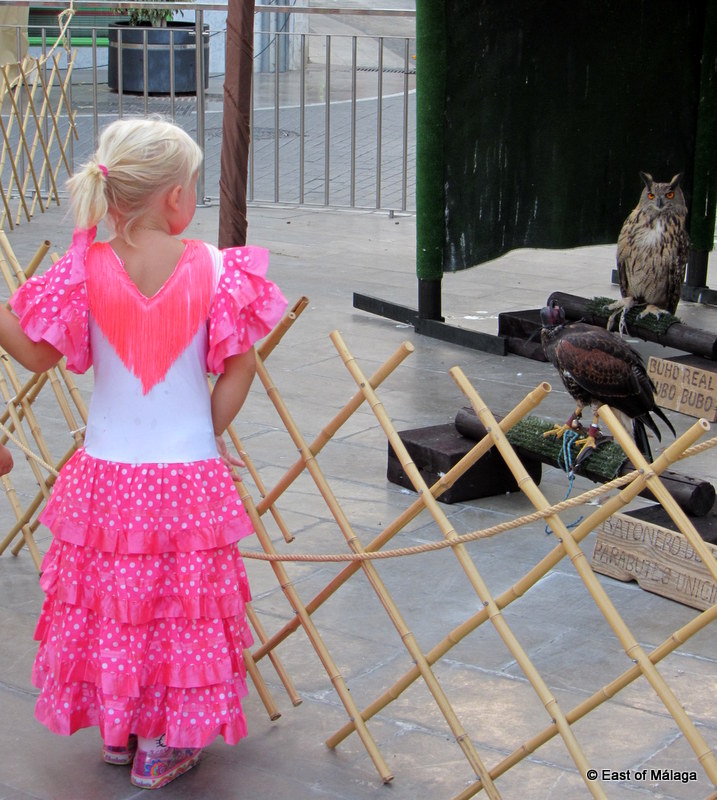
Little girl in traditional flamenco dress at the medieval market, Torrox pueblo.

This little lady in her bright pink flamenco dress was cautiously eyeing up some of the beautiful birds of prey at the Medieval Market in Torrox pueblo last year.

Pink cape of a bullfighter

Love it or hate it, bullfighting is a long standing tradition in Spain.  This is one of the auxiliary toreros (bullfighter or matador) in his elaborate embroidered costume, assisting the featured torero.   As evidenced here, it’s a myth to think that bulls are attracted by the colour red.  Cattle are colour-blind, and it is the movement of the cape (capote) that attracts them.  During the first phase of a bullfight, the bull is tested for it’s strength and aggressiveness by toreros using magenta and yellow capes.

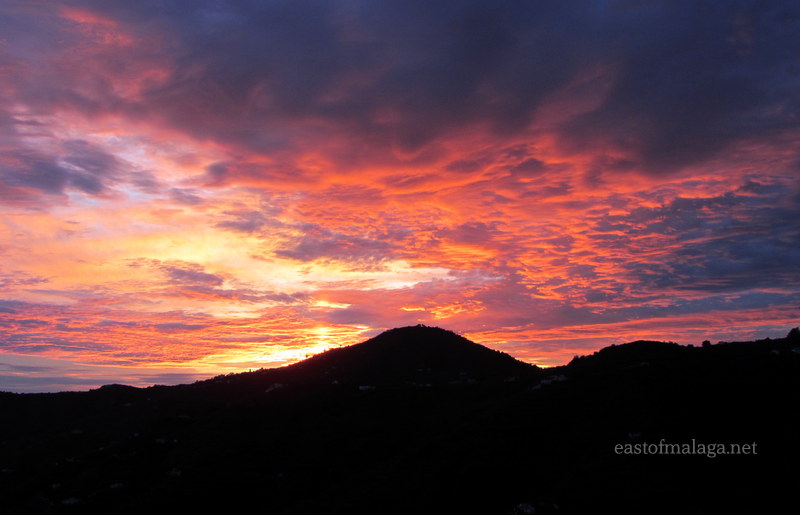
Sunset over nearby hills

I’ll finish with one of the beautiful sunsets, featuring shades of pink and yellow, developing into reds and purple that we regularly experience around the Axarquía region – east of Málaga.

My Featured Blog Links for this month:

**  Village Life in Andalucía reveals some of the secrets of living in a small inland village, deep in the heart of Andalucía.  John, sometimes referred to as “Pueblo Man” writes with a very easy style, and his latest offering,  The Not-so-Common Chameleon, reminds us that this beautiful little creature is on the endangered list.  I discovered the Village Life in Andalucía blog whilst I was trying to find out more about one of my favourite Spanish fish dishes – Rosada.  Fortunately, John answered my question, “What is Rosada?” by informing me that it’s not even a Spanish fish at all!  Sure is tasty though!  

**  Loren over at Cemetery Travel: Adventures in Graveyards Around the World describes herself as acemetery enthusiast devoted to cemeteries“.  Her latestCemetery of the Weekfeatures Drummond Hill Cemetery at Niagra Falls in Canada, but if you are interested in interment in Italy, France, China, India, England or around the USA, there’s something here for you.  So, if like me you are a taphophile, a tombstone tourist or a cemetery hunter, why not pop over to Loren’s blog, and tell them Marianne sent you!?

Conejo Blanco BLOG HOP Photo Challenge

So that´s the CBBH Photo Challenge for September, guys!

Remember, all you have to do is post your entry by the end of the month, tag your entry ‘CBBH Photo Challenge’,  link back to this blog and, most importantlydon´t forget to add links to any two blogs that you´ve commented on during the past month, so that we can all HOP OVER and have a look.  Make sure you FOLLOW THIS BLOG so you don´t miss next month´s exciting challenge!

For more information on how the CBBH Photo Challenge works click here.

I hope everyone taking part enjoys the exposure the CBBH Photo Challenge offers to featured blogs and, who knows, you may end up finding a new favourite!  I´m looking forward to seeing your interpretations.

[CBBH logo Image credit: (cc) Mostly Dans]

East of Málaga: Shall I compare thee to a Summer’s Day in England?

summertime east of malaga

Shall I compare thee to a summer’s day?
Thou art more lovely and more temperate:
Rough winds do shake the darling buds of May,
And summer’s lease hath all too short a date:
Sometime too hot the eye of heaven shines,
And often is his gold complexion dimm’d;
And every fair from fair sometime declines,
By chance or nature’s changing course untrimm’d;
But thy eternal summer shall not fade
Nor lose possession of that fair thou owest;
Nor shall Death brag thou wander’st in his shade,
When in eternal lines to time thou growest:
So long as men can breathe or eyes can see, 
So long lives this, and this gives life to thee.

~ William Shakespeare ~

Most of us are familiar with at least the opening lines of Sonnet 18 by English playwright and poet, William Shakespeare, in which he compares his beloved Fair Youth to that of an English summer’s day.

I’ve suffered endured experienced many cool and rainy summer days in England over the years, when the BBQ I had planned for friends has been a total washout, or no-one could sleep at night because it was too humid, despite being only 17 Celsius.

Of course, it’s not always like that in England but, here in southern Spain, the weather, whilst retaining distinct seasons, is much more reliable.  

The outdoor lifestyle was one of the main influencing factors for our move here, eight years ago.
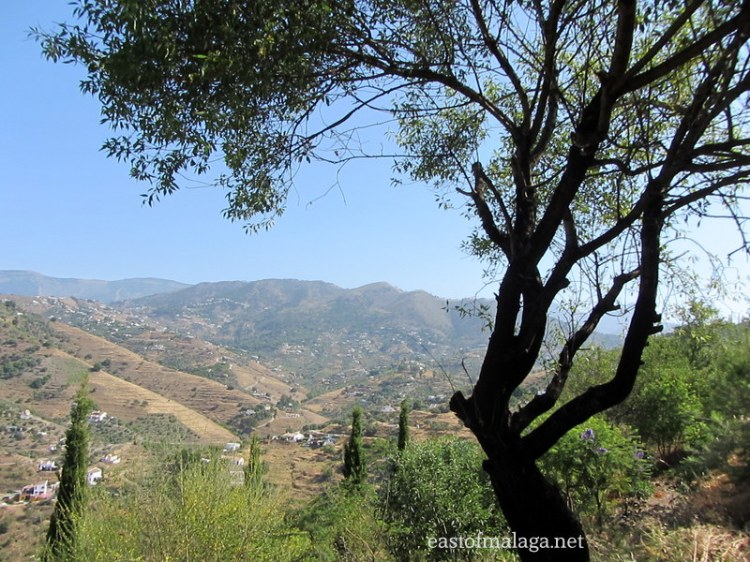
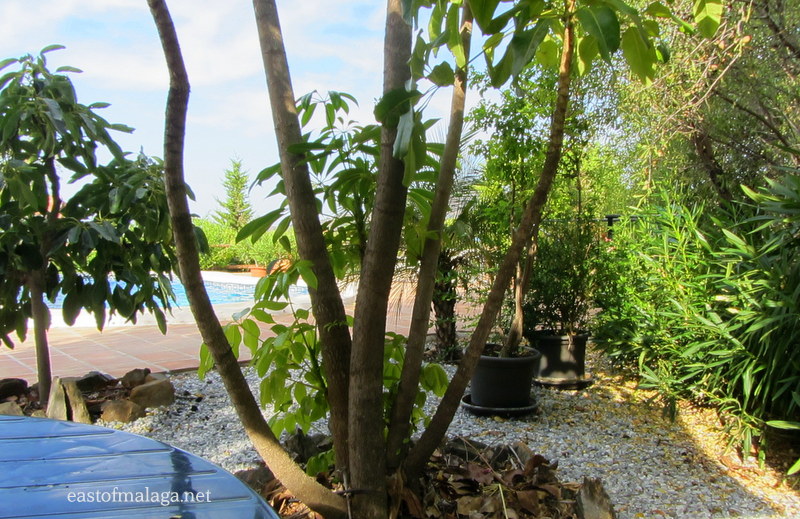
wandering around the garden

So, what is a summer’s day in July or August like – east of Málaga?

We would typically expect the temperature to be between 30 – 35 Celcius (that’s 86 – 95 Fahrenheit) during the day, with overnight temperatures rarely dropping below 21C (70 degrees Fahrenheit).  Clear blue skies are virtually guaranteed, with little or no rainfall and low humidity.

During August, the thermometer can sometimes touch 40C in the shade, so it’s vital to adapt your lifestyle accordingly.

August days often see me wandering around the house and garden in a swim suit and loose-fitting sarong, with my hair tied up, wearing no make-up. Carefree. And, because we live in the countryside a few kilometres from the coast,  days often go by without seeing another souland that suits me just fine. my office for today Not only do many northern European tourists head down this way for their annual vacation, but the rest of the population of Spain seems to end up around these parts, too.  So, we tend to stay at home, out of the way of the crowded restaurants and the lack of parking spaces, only venturing out when we need to buy groceries or if we choose to stroll along the promenade on a Saturday evening, before visiting a local chiringuito (fish restaurant).

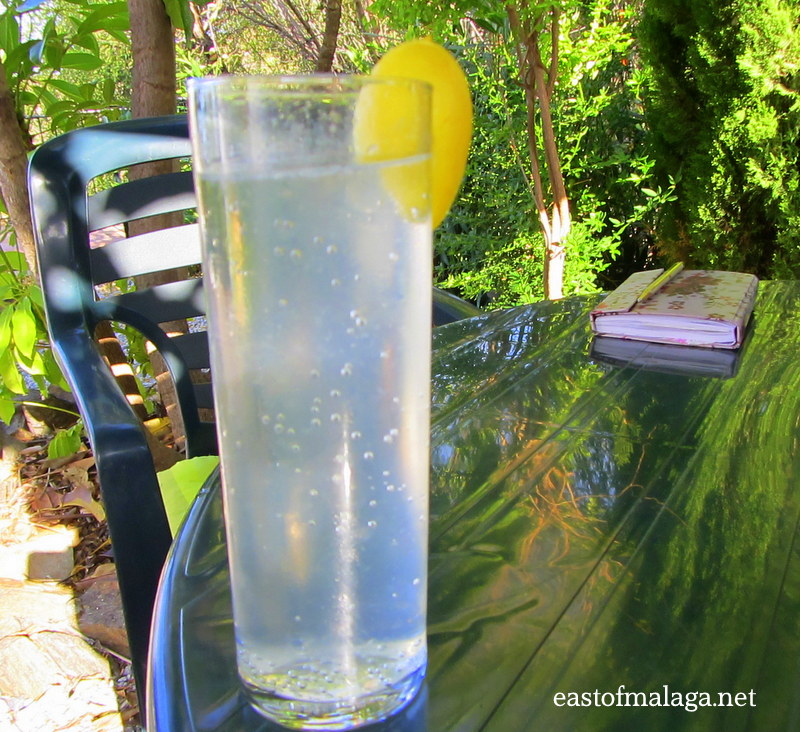
I’m an early riser, so the first thing I do when I get out of bed is to throw all the windows and doors open, allowing the cool morning air into the house.  Any chores that need doing are always completed well before 11am, by which time, the windows are closed to keep the warm air out. As the sun continues it’s journey around the house, various blinds are pulled down over the windows to stop the heat from penetrating. Sparkling water with fresh limequat My days are spent writing, wandering nearby taking photographs, sipping cool drinks, trying to catch up with my list of books to be read, or simply taking a dip in the pool when I get a bit overheated.
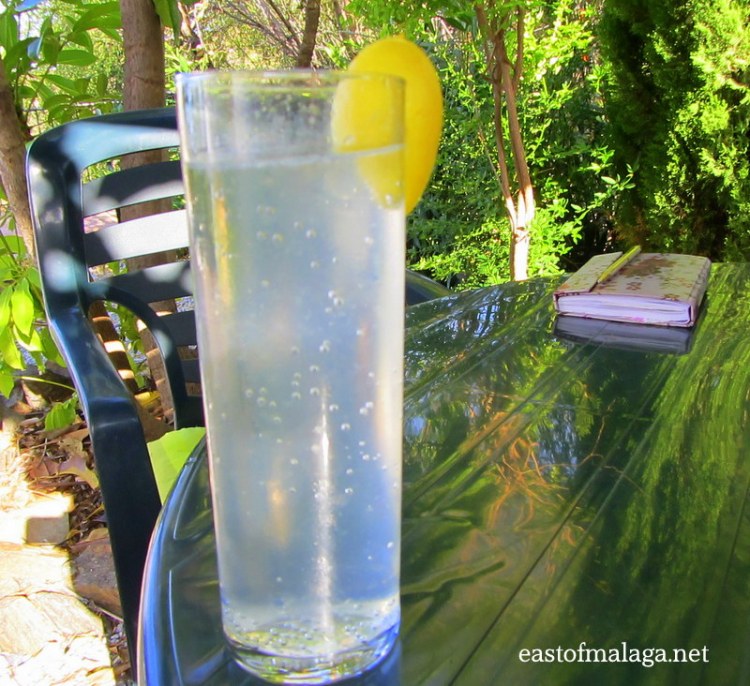
We have several cool, shady terraces where I choose to to locate my “office” for the morning.   Today’s lunch will be fillet of salmon with patatas a lo pobre, prepared earlier this morning, and made all the tastier knowing that the onions and green peppers have been grown in our vegetable patch.  I’m pretty sure that we’ll have a chilled glass of wine with lunch, too. 🙂

This afternoon, there could be a siesta, another swim or time to catch up reading blogs I enjoy.   I might even plan more of our next trip (to Portugal in October) or chat to friends around the world on the internet.

After sunset, the windows are once again thrown open, and it’s a delight to feel the cool evening air, as the delicious perfume of the night-scented jasmine pervades the surroundings.

One thing I love about hot, summer nights is the chance to have a swim after dark before hopping into bed.  I always make sure that there are no outside lights shining from the house and, because we live in the countryside, there is virtually no light pollution.  It´s quite surreal floating about in the pool on your back on an airbed watching the stars twinkling overhead. Sleep comes easily after such a carefree day, with the open window and overhead ceiling fan keeping me cool.

So, east of Málaga, shall I compare thee to a summer’s day in England?  NO, I’ll just enjoy every day spent in this beautiful country I have adopted as my home, and take English summers as, and when, I choose to find them.

You might enjoy these summer related articles, too:

Phew – what a scorcher!

Flying the Blue Flags on the beaches

Hummamole Dip – perfect for a summer’s day

The Eagle Aqueduct, Maro

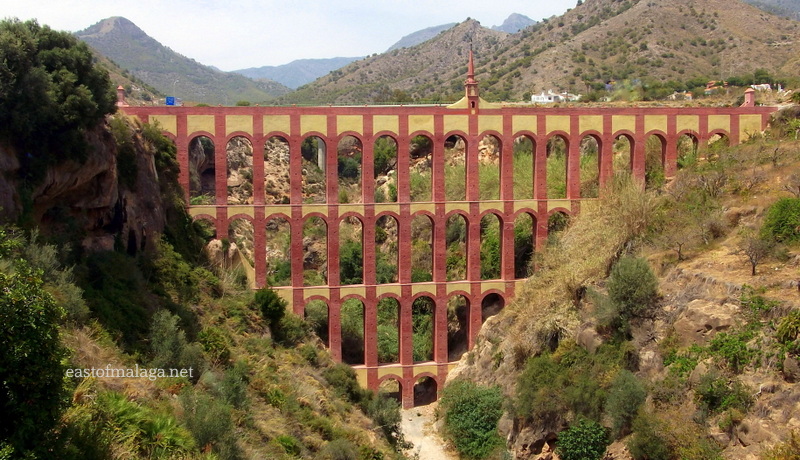
Eagle Aqueduct, Maro, Spain

The Eagle Aqueduct (El Puente del Águila) was built in the 19th century as a means of supplying water to the San Joaquín sugar factory on the outskirts of the town of Nerja.

Damaged during the Spanish Civil War, but recently restored, the Eagle Aqueduct comprises four storeys of superimposed brick arcades with 37 arches.   Soaring high above the spire at the central point of the structure is a weather vane in the shape of a double-headed eagle, from which the aqueduct takes its name.  The structure is 40 metres tall and 90 metres wide, with it’s design being typical of the period of construction, when the Mudéjar-style was very popular.

Situated on the Barranco de la Coladilla and spanning a ravine close to the Nerja Caves and the village of Maro, the aqueduct is visible from the old N340 coast road linking Nerja with Maro.   With a backdrop of the Sierra Almijara, it´s easy to see why this is one of the most photographed images of the local area.   There is a lay-by at the side of the road where you can leave the car to get a good view or to take photographs of the monument.  The area surrounding the aqueduct is public land and free to visit.

Strangely, the facade visible from the viewpoint is the rear of the construction, as the aqueduct faces north.   The Eagle Aqueduct was NOT built by the Romans, as many believe, though the remains of a Roman bridge and the old Roman road to Malaca (Málaga), were unearthed nearby.

Despite the closure of the San Joaquín sugar mill many years ago, the aqueduct continues to be used for the irrigation of local farmland.

Related articles:

Sweet memories: San Joaquín sugar mill

La Viñuela reservoir: Water levels

Travel theme: Architecture