Travel Theme: Multiples

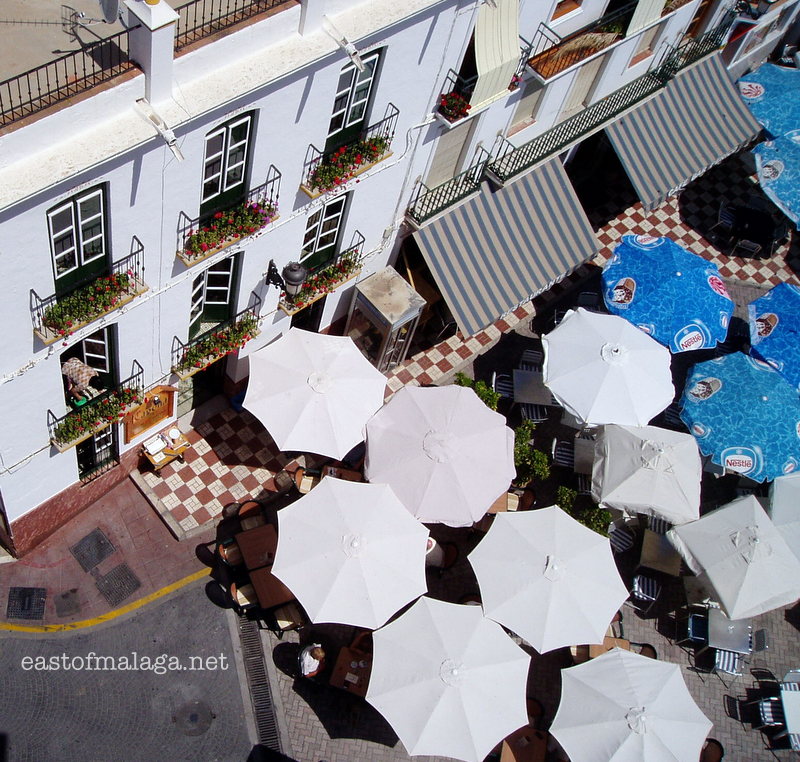
Looking down from Còmpeta church tower


Looking down from the tower of Còmpeta’s church at the many umbrellas shading customers at the bars and restaurants in Plaza Almijara.

This is my response to Travel Theme: Multiples


More photo challenges you might enjoy:

CBBH Photo Challenge: REFLECTION

Sunday Post: GOALS

Weekly Image of Life: WISHES FOR 2013


Menú del Día: Great food at a budget price

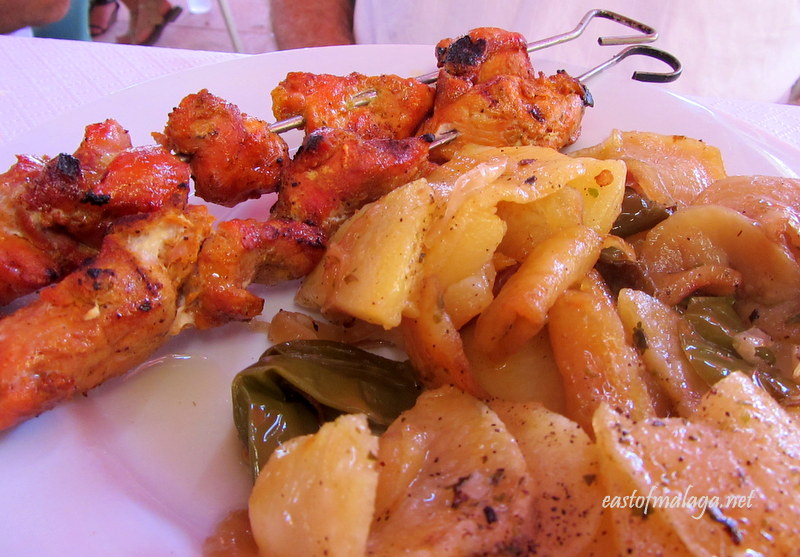
Pinchitos at Ferrara Asador, Torrox Costa

For much less than the cost of an evening dinner, most restaurants in La Axarquía have a cheap, fixed-price meal available at lunchtime only.

Because the normal Spanish working day has a 3 hour break in the middle, many Spanish workers take advantage of this time (often referred to as a siesta) by catching up with friends or colleagues over lunch.

Why eat a sandwich at your desk when you can enjoy a leisurely lunch with friends?

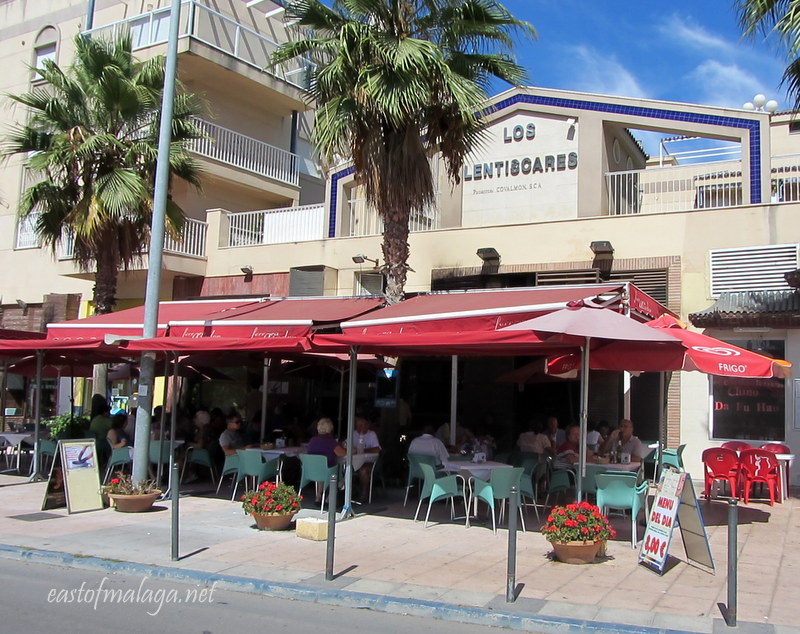
Ferrara Asadaor, Torrox Costa, Spain

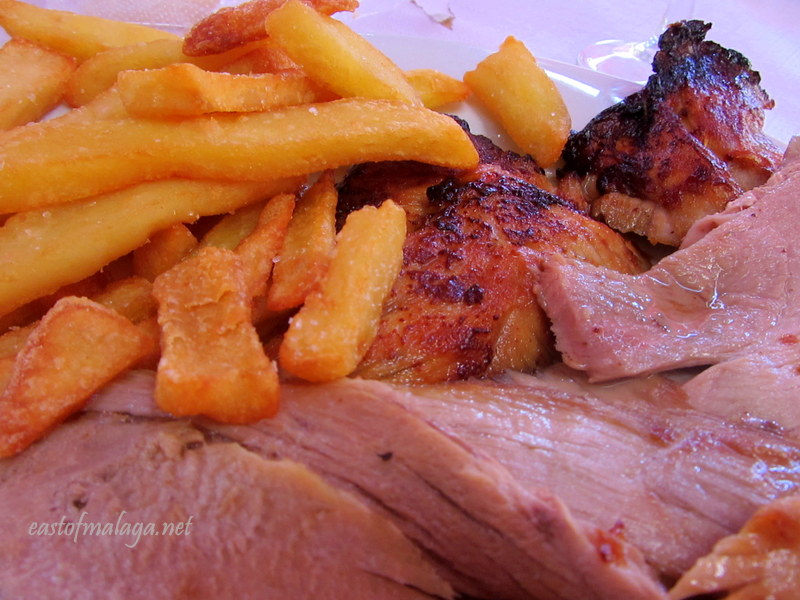
Roast pork at Ferrara Asador, Torrox Costa

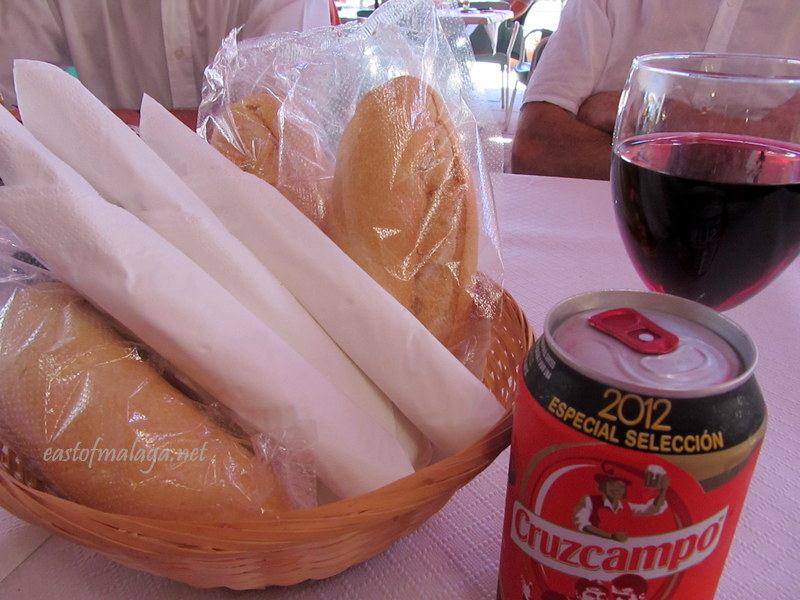
Drinks and bread included

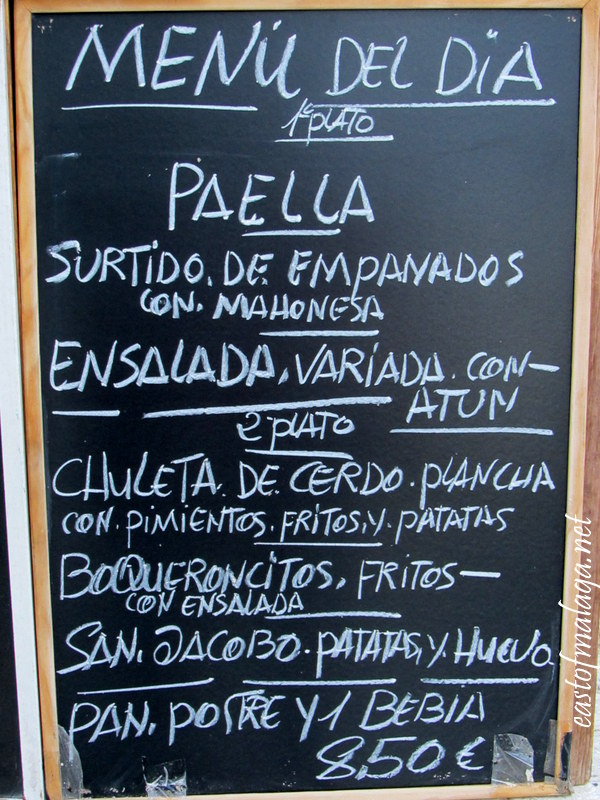
Known as Menu del Día, you can usually enjoy a two or three course meal, including bread and your first drink, for around 8 – 10 euros.  It´s usually a set menu, though there is often a choice of three or four dishes for each course.

A typical menu might include soup or salad to start, followed by fish or pork with flan or coffee to finish.  Bread, plus your choice of first drink (beer, wine or water) are usually included in the price.

Typical board advertising Menu of the Day, Spain

Look out for a board outside the restaurant, advertising the Menu del Día, which will usually be written in Spanish, and always remember to look out for restaurants and bars frequented by locals rather than tourists.

My choice in Torrox Costa:

** Ferrara Asador on the N340, near to the Repsol garage.  At only €8 with great service, good choice and quality of food, it´s well worth a visit, but go before 2.00pm as it gets very busy, especially in August.

** Fancy something a bit different ?  Try the Jing Chinese restaurant on the Paseo Maritimo along Ferrara Beach.  Their menu del día is even cheaper at €6, but drinks cost extra.  Again, excellent food and service.

Where´s your favourite place to eat, east of Málaga?

Love food?  You might like to drool over these posts:

Slice of Life:  Spanish bars

Let´s talk about tapas!

Fresh Figs Stuffed with Goat´s Cheese and wrapped in Smoked Bacon

Patatas a lo pobre: Poor man´s potatoes

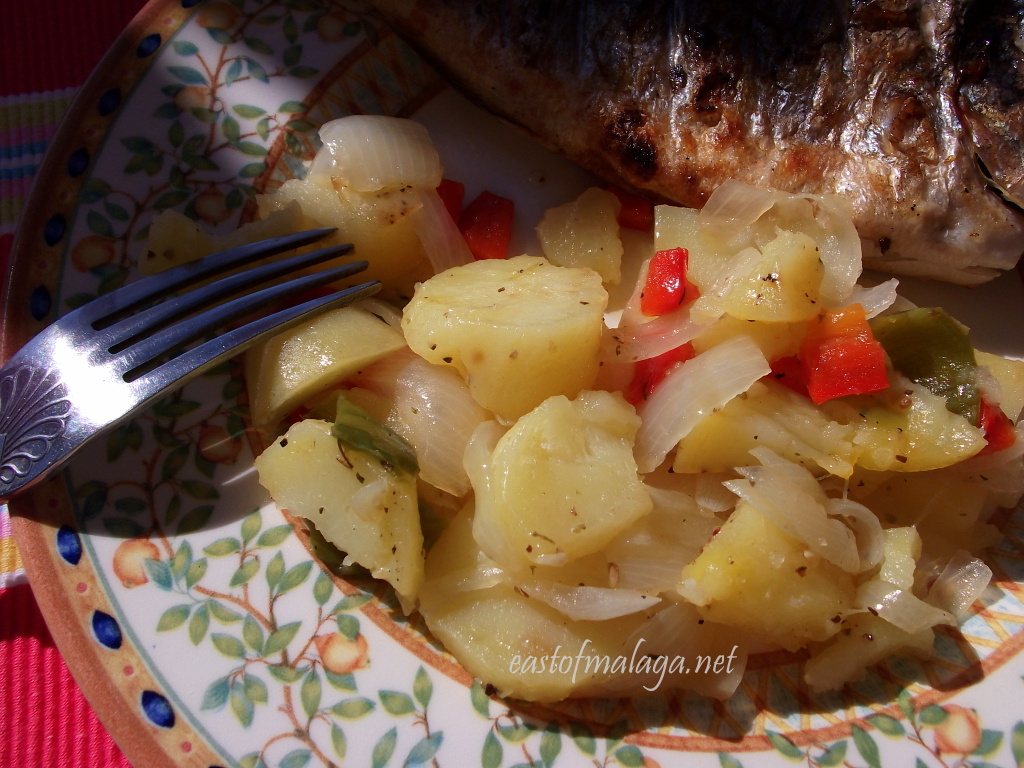
Patatas a lo pobre is a classic Andalucían dish that can be served either as tapas, or to accompany a wide variety of fish and chicken dishes.

I have my own version that I sometimes cook in the microwave, using less olive oil than in the traditional way of cooking in a frying pan.  It is just as delicious!

Ingredients (adjust according to taste/numbers):

Potatoes, sliced

Onions, sliced

Garlic, chopped

Green peppers (Italian), sliced

Red pepper, sliced  (I just add a small amount for the colour)

Salt and pepper

Mixed herbs

Extra virgin Olive oil

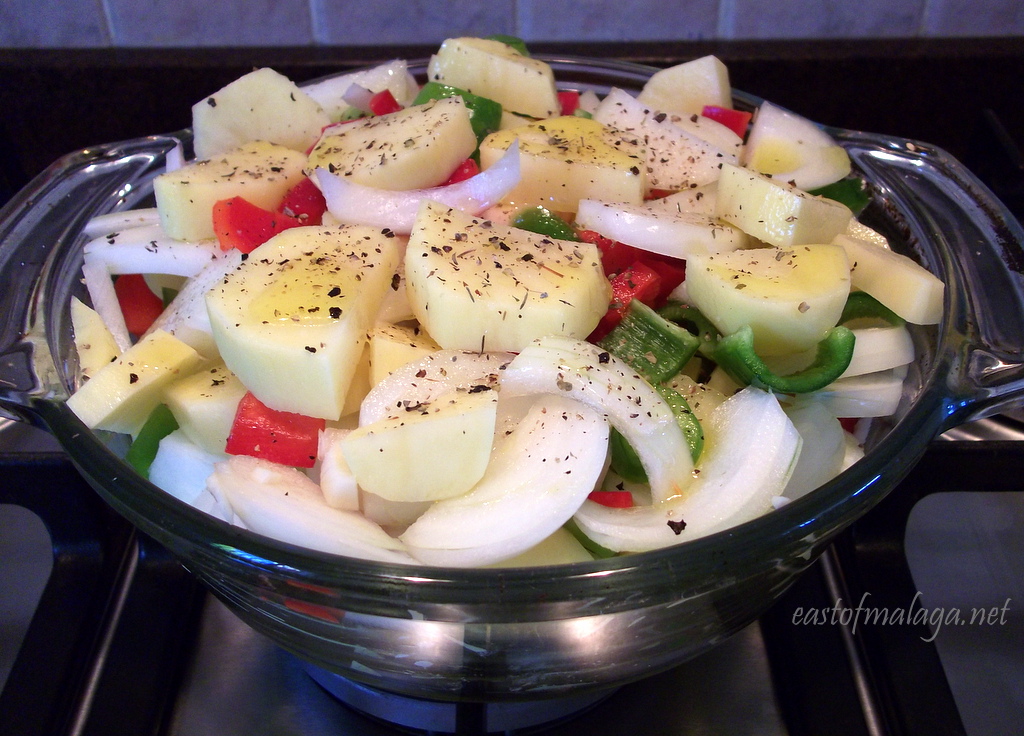
Patatas a lo pobre - ingredients

Layer the ingredients into a glass Pyrex-type dish, drizzle with olive oil, cover with pierced cling-film and microwave on full power for approximately 20 minutes (or until potatoes are cooked).  I usually check about halfway through, give it a little mix around and add more olive oil if I feel I need to.

Que aproveche!

Have you ever tried cooking tapas, at home?

You might also enjoy these posts too:

Fresh Figs Stuffed with Goat´s Cheese and wrapped in Smoked Bacon

Let’s talk about tapas!

All at sea with the Virgen del Carmen

Venturing further afield: A long weekend in Santander

We love to travel not only locally, but throughout Spain, so I will also include information, from time to time, about where we have visited.  Usually these places can either be driven to within a few hours of our home, east of Málaga, or we will have flown there from Málaga (AGP) airport.

Banco de Santander

It´s pretty easy to pick up some cheap flights from Mágaga to Santander, the elegant capital city of the province of Cantabria, which is located on the northern coast of Spain, between Asturias and the Basque Country, overlooking the Bay of Biscay.

The port city of Santander has many clean, golden beaches and is home to the magnificent coastal resort of El Sardinero, which became popular with the Spanish upper classes during the late 19th century.  The wonderful beaches together with the promenade and the Magdalena Peninsula are some of the main attractions for tourists.

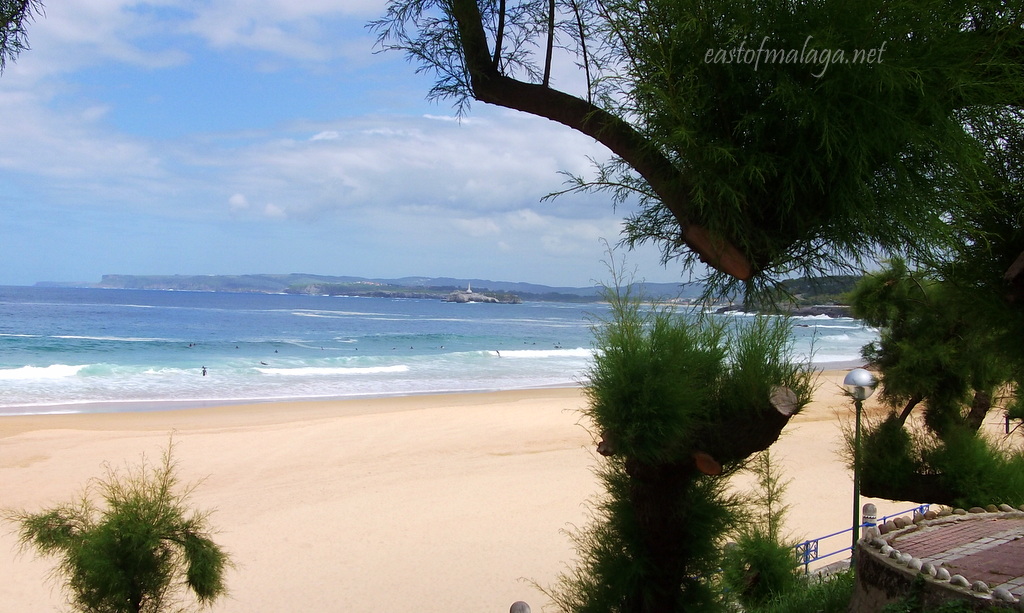
El Sardinero Beach, Santander, Spain

El Sardinero Beach views, Santander, Spain

Santander fell victim to a great fire in 1941.   Fanned by a strong southerly wind, the fire burned for two days, destroying the greater part of the medieval town centre and gutting the city’s Romanesque cathedral.  The historic quarter includes a number of majestic buildings which are situated against an incredible natural backdrop of sea and mountains.

In the early part of the 20th century King Alfonso XIII chose this part of the Cantabrian coast as his summer retreat and many fine buildings sprung up to accommodate the needs of the aristocracy and court officials who followed the King and Queen.

Elegant buildings in Santander, Spain

Santa Iglesia Cathedral, Santander, Spain

Town Hall, Santander, Spain

Of course, one of the more pleasant things to do in Santander is to bustle along with the locals towards the many superb tapas bars in the old part of the city.  It´s amazing what a good glass of Rioja Crianza and a mouthful of seafood can do for you!

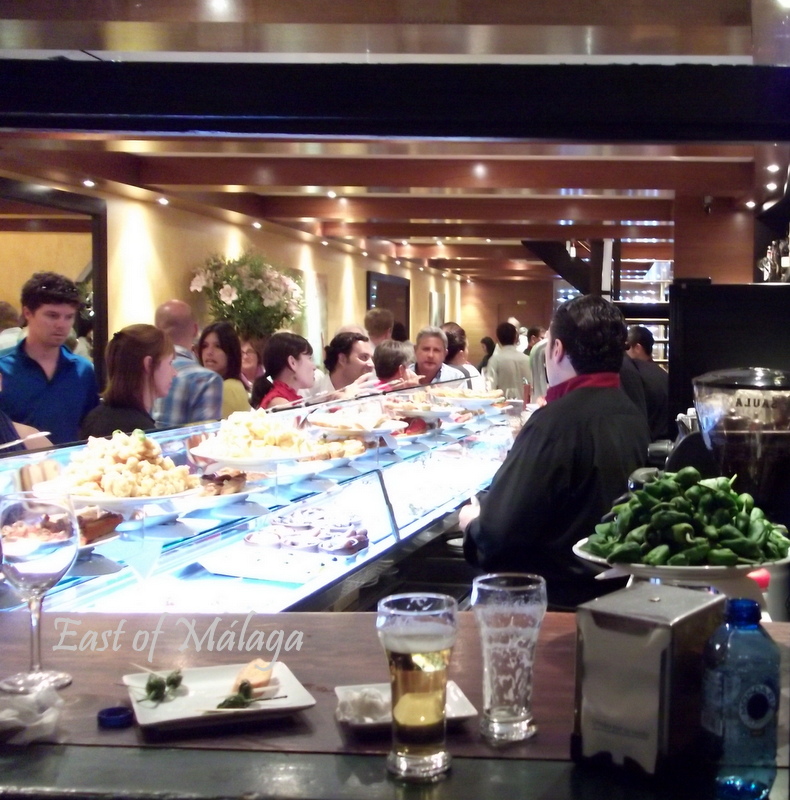
We spent our evenings strolling along the streets seeking out the busiest tapas bars – with their customers spilling out onto the pavements outside –  and diving straight in there, to try out our next round of  scrummy pintxos.

Rioja and scrummy tapas at a bar in Santander, Spain

Santander also provides a great base for touring many well-known cities and sights in northern Spain, which are located right on it´s doorstep.   There´s the  Guggenheim Museum in Bilbao, the Picos de Europa – wheresome of the highest mountains in Europe are to be found, as well as the gastronomic delights of the picturesque city of San Sebastian in the heart of Basque country – but you´ll have to wait for me to tell you about those another time!

You might also enjoy:

The heart of Cómpeta: El Paseo de las Tradiciones

A Weekend Away: Santiago de Compostela

Slice of Life: Spanish bars

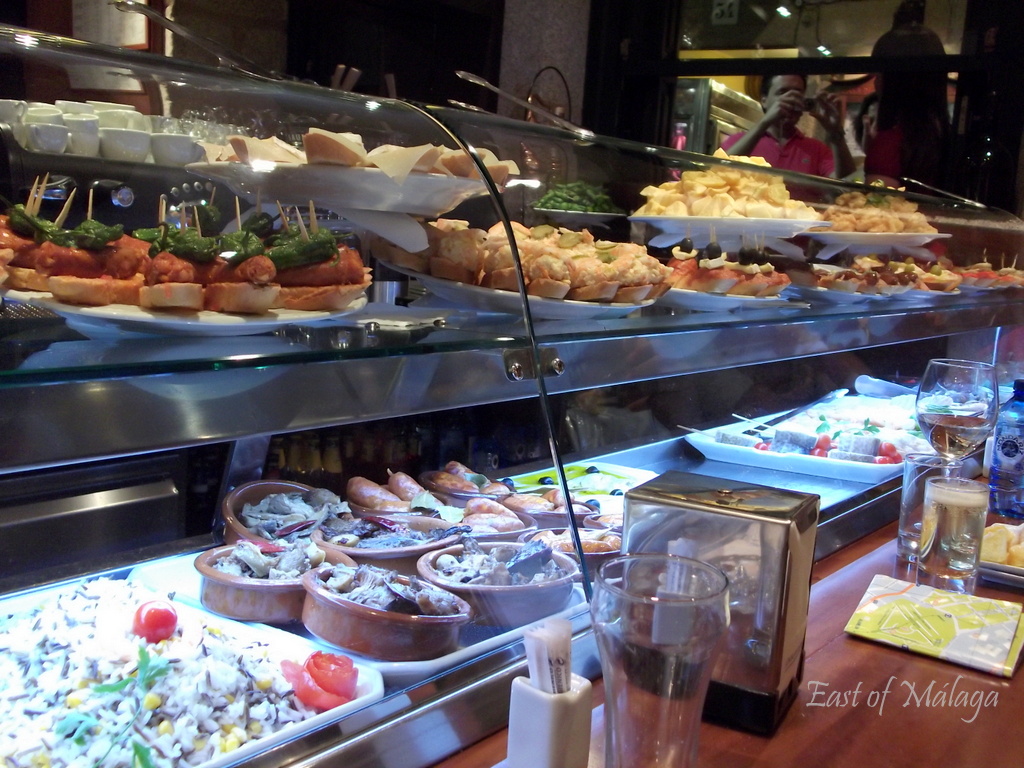
A bar here in southern Spain is very different from a typical British pub.  Although layouts may vary, what you will usually find will be a bar counter, with tall seats around, often with a covered tapas display. This will likely be in two parts, one containing meats and tortillas ready to be heated up and served with your drink, the other with cold tapas and salads. Many bars still serve tapas at an inclusive price with the drink, whilst others serve rather more elaborate nibbles which are charged for individually.
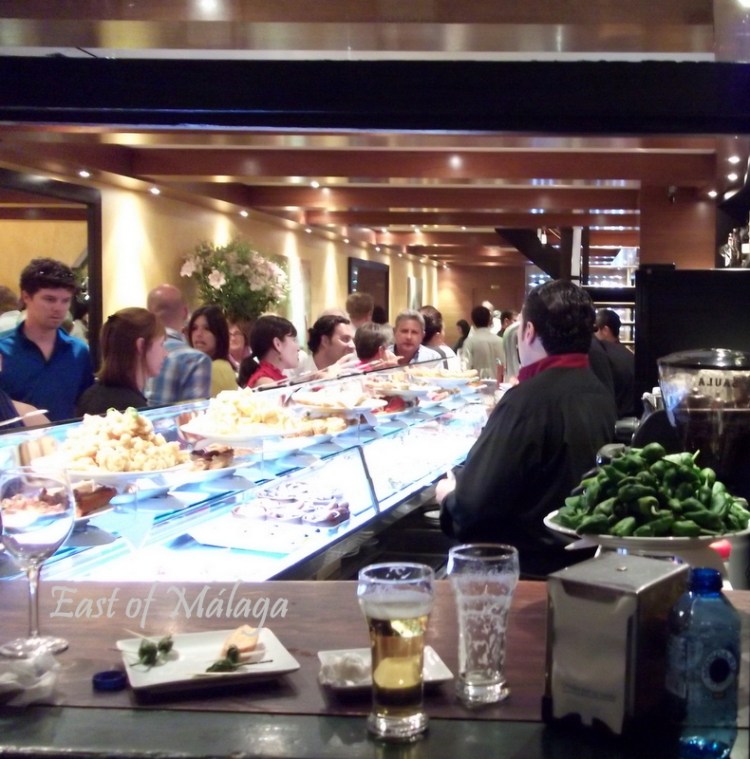
typical tapas bar
One of the main differences with a British pub will be the size of drink. Normally if you ask for a beer (una cerveza) it will be in a smaller glass, either a “tubo” which is a tall tumbler or in a glass not dissimilar to a large wine glass. The only time you will see anyone with a “pint” glass, they will usually be a tourist on the coast.  You will be just as likely to see people at the bar drinking coffee (un café) or a glass of wine (una copa de vino).

Tables away from the bar counter, either inside or outside, are typical café tables with upright chairs, not lounge-type tables and chairs like in British pubs .

There is usually a large display of spirit bottles behind the bar and invariably a leg of Serrano ham on a carving frame.  You should try this typical Spanish  delicacy –  it´s delicious!

Almost everywhere,  customers take all their food and drink and only pay when they are ready to leave.  In busy big city bars, the tapas, usually more sophisticated, will each come with a small wooden skewer and, when you have finished, the barman will count the skewers and charge accordingly.
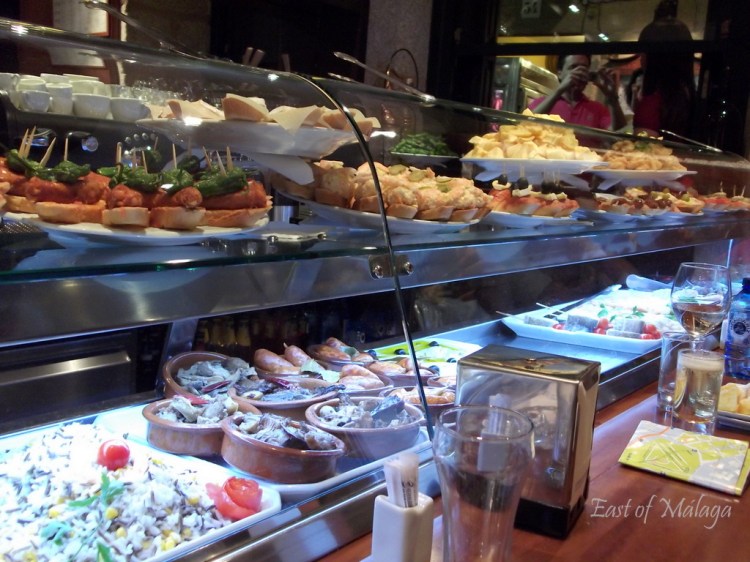
Tapas to choose

I would recommend you to visit as many bars and cafeterías as possible, especially away from the tourist haunts. Look for places full of Spaniards and litter, in the form of till receipts, on the floor signifying that you have found a good spot.

Some bars, especially on the coast, offer more seafood, but try different ones and you will inevitably find a handful that will become part of your regular tapas trail.

Where´s your favourite Spanish bar?

If you like this article….try also looking here:

The heart of Cómpeta: El Paseo de las Tradiciones

Photographs I love …. and why!

A flowering snapshot of a January day