
Statue of Nazareno and child outside Iglesia de San Juan Bautista, Vélez-Málaga.
Related articles:
Holy Week (Semana Santa) in Spain
Wordless Wednesday: Fire in the Campo
Wordless Wednesday: Balcón de Europa, Nerja
Statue of Nazareno and child outside Iglesia de San Juan Bautista, Vélez-Málaga.
Related articles:
Holy Week (Semana Santa) in Spain
Wordless Wednesday: Fire in the Campo
Wordless Wednesday: Balcón de Europa, Nerja
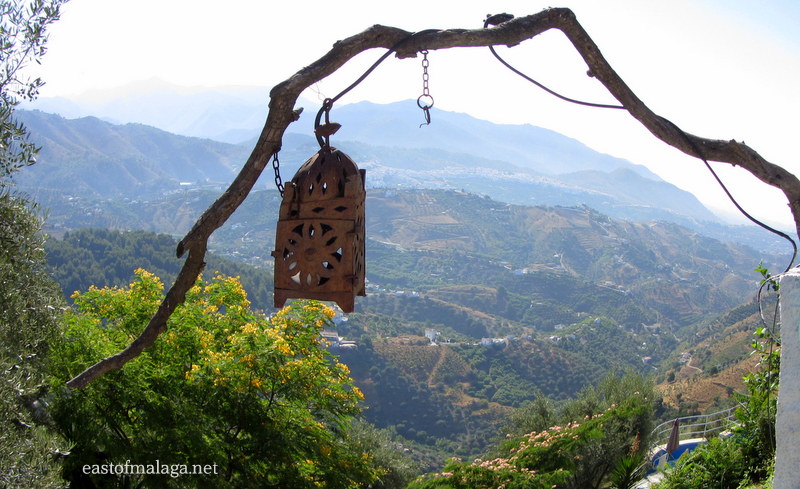
Shall I compare thee to a summer’s day?
Thou art more lovely and more temperate:
Rough winds do shake the darling buds of May,
And summer’s lease hath all too short a date:
Sometime too hot the eye of heaven shines,
And often is his gold complexion dimm’d;
And every fair from fair sometime declines,
By chance or nature’s changing course untrimm’d;
But thy eternal summer shall not fade
Nor lose possession of that fair thou owest;
Nor shall Death brag thou wander’st in his shade,
When in eternal lines to time thou growest:
So long as men can breathe or eyes can see,
So long lives this, and this gives life to thee.
~ William Shakespeare ~
Most of us are familiar with at least the opening lines of Sonnet 18 by English playwright and poet, William Shakespeare, in which he compares his beloved Fair Youth to that of an English summer’s day.
I’ve suffered endured experienced many cool and rainy summer days in England over the years, when the BBQ I had planned for friends has been a total washout, or no-one could sleep at night because it was too humid, despite being only 17 Celsius.
Of course, it’s not always like that in England but, here in southern Spain, the weather, whilst retaining distinct seasons, is much more reliable.
The outdoor lifestyle was one of the main influencing factors for our move here, eight years ago.
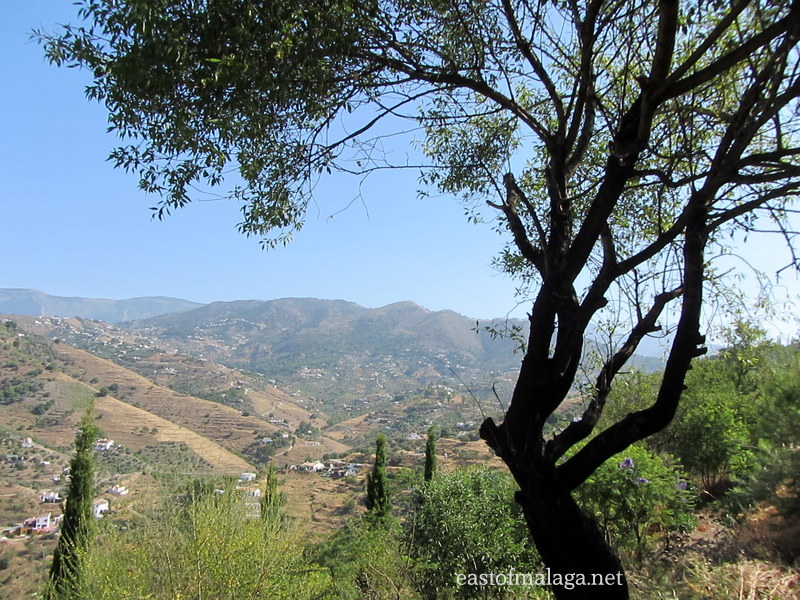
So, what is a summer’s day in July or August like – east of Málaga?
We would typically expect the temperature to be between 30 – 35 Celcius (that’s 86 – 95 Fahrenheit) during the day, with overnight temperatures rarely dropping below 21C (70 degrees Fahrenheit). Clear blue skies are virtually guaranteed, with little or no rainfall and low humidity.
During August, the thermometer can sometimes touch 40C in the shade, so it’s vital to adapt your lifestyle accordingly.
August days often see me wandering around the house and garden in a swim suit and loose-fitting sarong, with my hair tied up, wearing no make-up. Carefree. And, because we live in the countryside a few kilometres from the coast, days often go by without seeing another soul – and that suits me just fine. 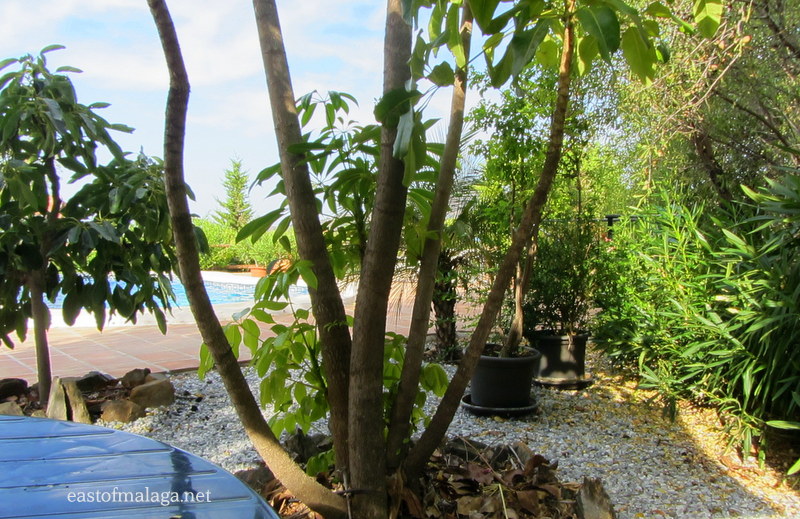 Not only do many northern European tourists head down this way for their annual vacation, but the rest of the population of Spain seems to end up around these parts, too. So, we tend to stay at home, out of the way of the crowded restaurants and the lack of parking spaces, only venturing out when we need to buy groceries or if we choose to stroll along the promenade on a Saturday evening, before visiting a local chiringuito (fish restaurant).
I’m an early riser, so the first thing I do when I get out of bed is to throw all the windows and doors open, allowing the cool morning air into the house. Any chores that need doing are always completed well before 11am, by which time, the windows are closed to keep the warm air out. As the sun continues it’s journey around the house, various blinds are pulled down over the windows to stop the heat from penetrating. 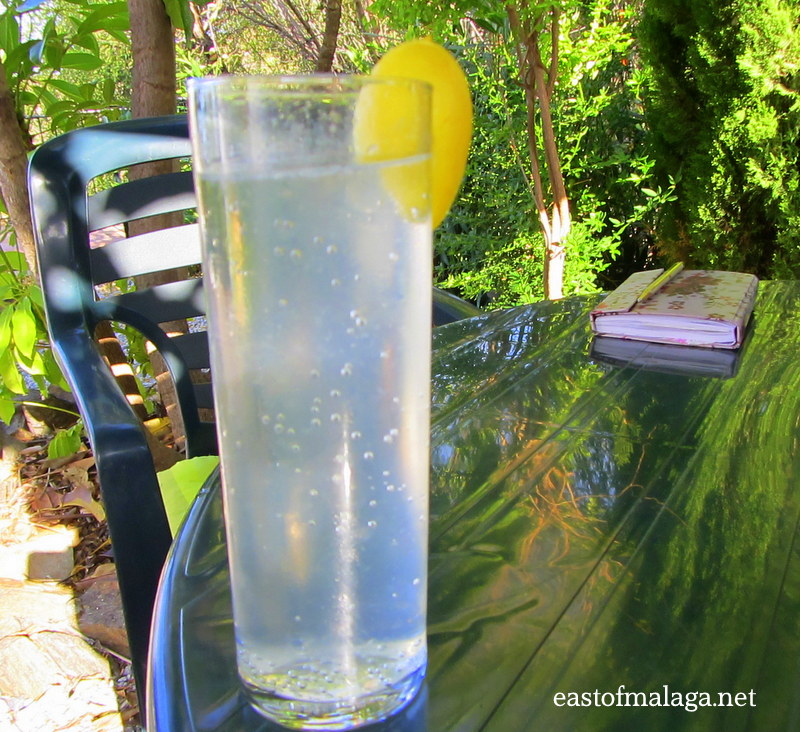 My days are spent writing, wandering nearby taking photographs, sipping cool drinks, trying to catch up with my list of books to be read, or simply taking a dip in the pool when I get a bit overheated.
We have several cool, shady terraces where I choose to to locate my “office” for the morning. Today’s lunch will be fillet of salmon with patatas a lo pobre, prepared earlier this morning, and made all the tastier knowing that the onions and green peppers have been grown in our vegetable patch. I’m pretty sure that we’ll have a chilled glass of wine with lunch, too. 🙂
This afternoon, there could be a siesta, another swim or time to catch up reading blogs I enjoy. I might even plan more of our next trip (to Portugal in October) or chat to friends around the world on the internet.


After sunset, the windows are once again thrown open, and it’s a delight to feel the cool evening air, as the delicious perfume of the night-scented jasmine pervades the surroundings.
One thing I love about hot, summer nights is the chance to have a swim after dark before hopping into bed. I always make sure that there are no outside lights shining from the house and, because we live in the countryside, there is virtually no light pollution. It´s quite surreal floating about in the pool on your back on an airbed watching the stars twinkling overhead. Sleep comes easily after such a carefree day, with the open window and overhead ceiling fan keeping me cool.
So, east of Málaga, shall I compare thee to a summer’s day in England? NO, I’ll just enjoy every day spent in this beautiful country I have adopted as my home, and take English summers as, and when, I choose to find them.
You might enjoy these summer related articles, too:
Flying the Blue Flags on the beaches
Hummamole Dip – perfect for a summer’s day
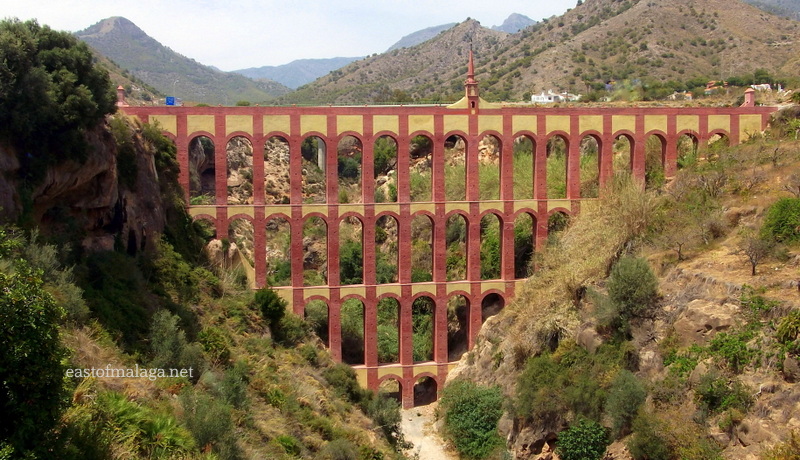
The Eagle Aqueduct (El Puente del Águila) was built in the 19th century as a means of supplying water to the San Joaquín sugar factory on the outskirts of the town of Nerja.
Damaged during the Spanish Civil War, but recently restored, the Eagle Aqueduct comprises four storeys of superimposed brick arcades with 37 arches. Soaring high above the spire at the central point of the structure is a weather vane in the shape of a double-headed eagle, from which the aqueduct takes its name. The structure is 40 metres tall and 90 metres wide, with it’s design being typical of the period of construction, when the Mudéjar-style was very popular.
Situated on the Barranco de la Coladilla and spanning a ravine close to the Nerja Caves and the village of Maro, the aqueduct is visible from the old N340 coast road linking Nerja with Maro. With a backdrop of the Sierra Almijara, it´s easy to see why this is one of the most photographed images of the local area. There is a lay-by at the side of the road where you can leave the car to get a good view or to take photographs of the monument. The area surrounding the aqueduct is public land and free to visit.
Strangely, the facade visible from the viewpoint is the rear of the construction, as the aqueduct faces north. The Eagle Aqueduct was NOT built by the Romans, as many believe, though the remains of a Roman bridge and the old Roman road to Malaca (Málaga), were unearthed nearby.
Despite the closure of the San Joaquín sugar mill many years ago, the aqueduct continues to be used for the irrigation of local farmland.
Related articles:
Sweet memories: San Joaquín sugar mill
La Viñuela reservoir: Water levels
Last summer, I was invited by another expat blogger to join her for a walking tour around her adopted home village of Colmenar.
Set in the heart of the Montes de Mâlaga, a range of mountains close to Málaga city, Colmenar gets it’s name from the Spanish word for the bee hives (las colmenas de abejas) that were the basis of the local economy for a long time. Indeed, Colmenar boasts a museum dedicated entirely to honey (Casa Museo de la Miel), although for some strange reason the museum was closed when we visited.

At the highest point of the village stands the Chapel of Our Lady of Candelaria. The Virgin of Candelaria is the patron saint of Colmenar, as well as the Spanish-owned Canary Islands, and the chapel was built in gratitude for the lives of Canarian sailors spared during a fierce storm off the Málaga coast, during the 17th century.
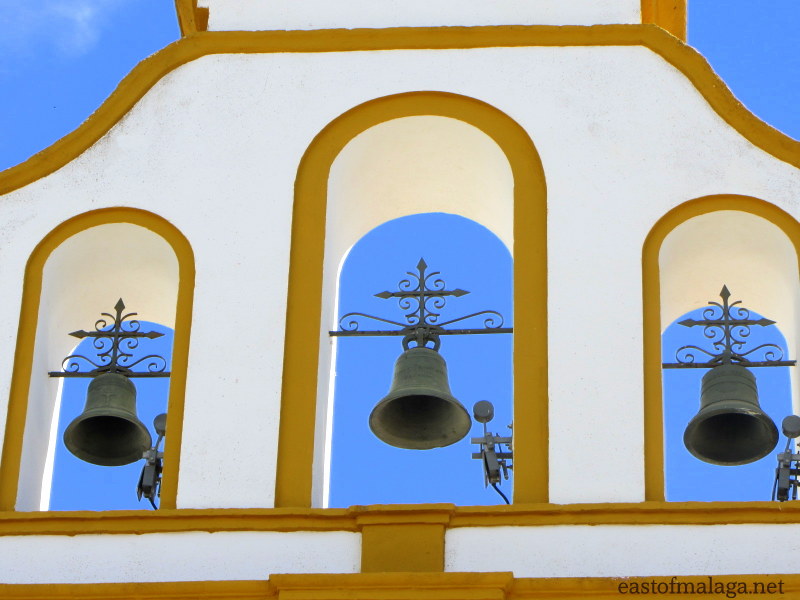
This post is my response to the Weekly Photo Challenge: One Shot, Two Ways
Related articles:
The Bullfighters’ Chapel, Ronda
Weekly Photo Challenge: Fleeting
Believe it or not, it’s one year to the day since I published my first CBBH Photo Challenge. How time flies when you are taking photographs!
Anyway, for this month’s challenge, if I were to I say “Ancient and Modern” – what would you think of? Would it be hymns, languages, history, art, the Olympics or maybe architecture? Within one photograph, I want you to show me your interpretation of Ancient and Modern.
Don’t forget that the CBBH Photo Challenge is a little different from some other challenges, in two ways. First, it’s only once a month – giving you lots of time to consider your entry before the end of the calendar month. Second, and most important, this is a BLOG HOP (after all, it is the CBBH – Conejo Blanco Blog Hop, meaning white rabbit in Spanish), so DON’T FORGET that in your post you need to add links to two blogs that you have visited and commented on, during the past month. That way, when we visit each other, we can HOP OVER to your links, connect with others and share a little blog love around!
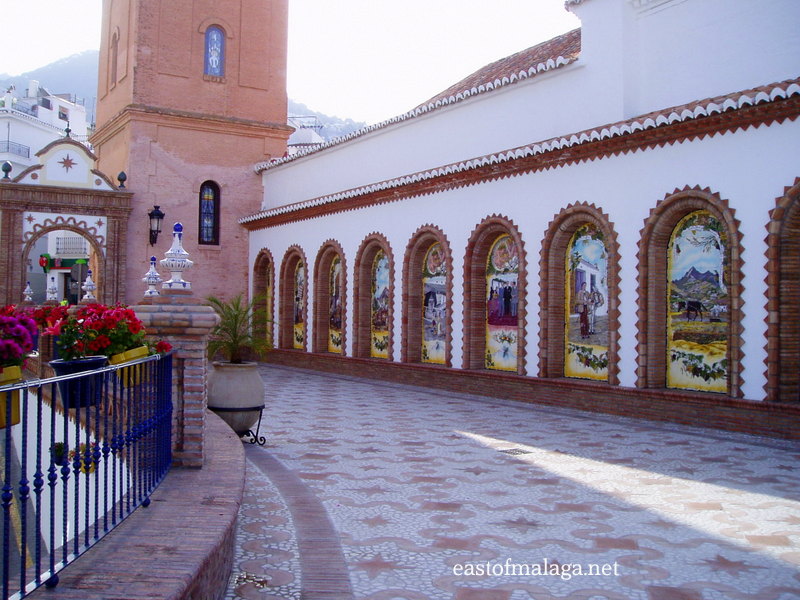
I’ve blogged before about El Paseo de las Tradiciones in the white village of Cómpeta, but it’s a perfect example of the beautiful modern ceramic murals celebrating the lives of generations of the working people of the village, annexed to the 500 year old Church of Our Lady of the Assumption (La Iglesia de Nuestra Señora de la Asunción).
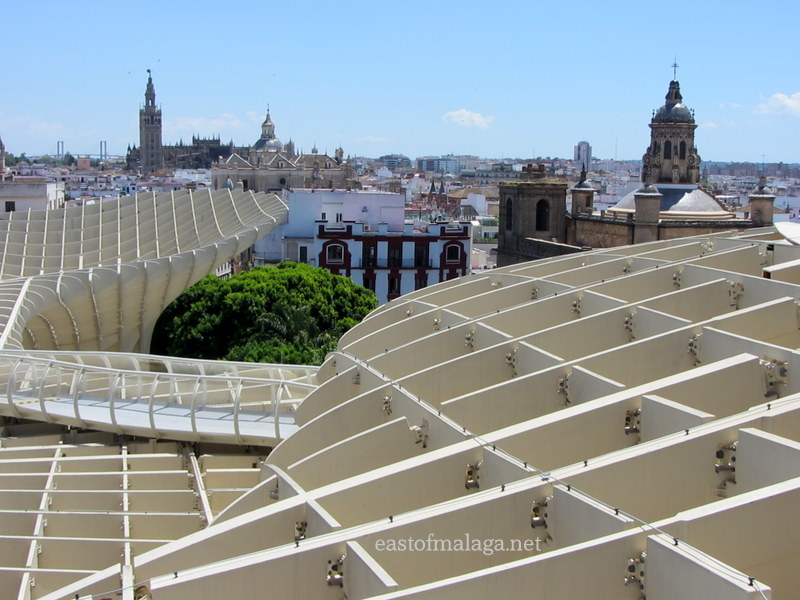
Here you can see the 15th century Cathedral in Seville, with its famous Giralda Bell Tower, as viewed from the very modern Metropol Parasol. More popularly known as Las Setas (the mushrooms), this huge wooden structure was built between 2005 and 2011 in the heart of the city. It seems people either love it, or hate it. I LOVE it!
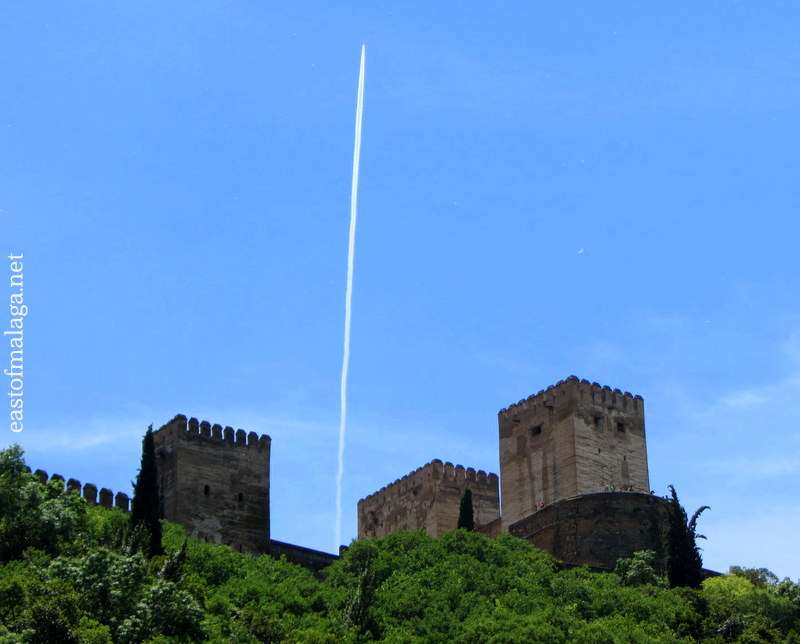
Back in May, I visited the city of Granada and, whilst we were having lunch in one of the wisteria-covered restaurants in Paseo de los Tristes, in the shadow of the Alhambra, I grabbed my camera when I saw a jet appear above the turrets of the ancient monument. It was this shot that first gave me the idea of this month’s theme.
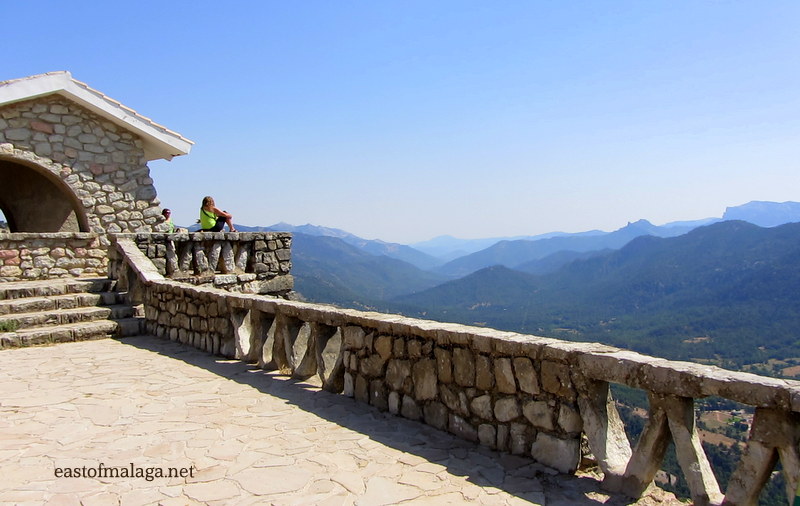
And finally, this modern stone architectural structure (known in Spain as a mirador – or look-out point) is sited to take advantage of a the scenic view over the UNESCO World Heritage Cazorla National Park in Jaén province. The Parque Natural de las Sierras de Cazorla, Segura and La Villas, to give its complete name, is Spain’s largest national park and the second largest in Europe. It’s marvellous to just gaze out and wonder at who has looked across these same mountains in days gone by.
** Spain for pleasure follows the adventures, misadventures and quiet musings of an earnest (British) expat living “la vida loca” in Granada. I was amazed (and envious) to read Josh’s tale of when he played a part in the best EVER water-fight in Lanjaron, but one of my favourite posts is his “Piste 2 Playa Project” when he took the ultimate day trip from Granada to ski in the morning in the Sierra Nevada mountains and sunbathe on a Mediterranean beach in the afternoon. Quite why he had to do it dressed in a giraffe onesie (especially on a nudist beach) is beyond me – but that’s Josh for you!! When he’s not having such interesting adventures, Josh earns his keep teaching English as a foreign language, so if this is something you might be interested in, head over and take a look at his blog. You’re sure to find something of interest – I always do!
** con jamón spain are a couple of Brits who have recently moved from London, England to live in Órgiva, in the popular Alpujarras region of Andalucía, for one year. Set in the foothills of the Sierra Nevada mountains, Órgiva is situated an hour and three quarters’ drive east from Málaga, and 45 minutes south from the city of Granada. Con jamon spain are a couple of carnivores who have totally changed how they live over the past few weeks, and have discovered how to make delicious vegetarian pizzas, using fresh produce bought from the local Thursday market. Their regular posts make me want to jump in the car and visit Órgiva, right away – especially if it involves watching goats eating sugar cane, right at the end of their road! I’d love you to pop over, say “HOLA” to them and follow their adventures – I’m sure you’ll have a great time 🙂

So that´s the CBBH Photo Challenge for August, folks!
Remember, all you have to do is post your entry by the end of the month, tag your entry ‘CBBH Photo Challenge’, link back to this blog and, most importantly, don´t forget to add links to any two blogs that you´ve commented on during the past month, so that we can all HOP OVER and have a look. Make sure you FOLLOW THIS BLOG so you don´t miss next month´s exciting challenge!
For more information on how the CBBH Photo Challenge works click here.
I hope everyone taking part enjoys the exposure the CBBH Photo Challenge offers to featured blogs and, who knows, you may end up finding a new favourite! I´m looking forward to seeing your interpretations.
[CBBH logo Image credit: (cc) Mostly Dans]


 East of Málaga
