This year’s Tomatina Festival at Buñol, Spain

La Tomatina Festival, SpainImage credit Flickr CC: agsaran

WELCOME TO THE WORLD’S LARGEST FOOD FIGHT!

If you are thinking of heading to the village of Buñol, near Valencia, for this year’s tomato-throwing La Tomatina Festival, be warned that you now need a ticket to take part!

The annual festival, which takes place each year on the last Wednesday in August, has been attracting such huge crowds that a ticketing system has had to be introduced.  Only 20,000 tickets will be issued (40,000 people attended last year’s festival) at a cost of 10 euros each – creating a new “sauce” of income for the local council! 15,000 of the tickets will be made available to the general public, with the other 5,000 reserved for local residents. You can buy your tickets at this website (in English)

Happy throwing!

You might enjoy these articles, too:

A weekend away in Santiago de Compostela

How to make the perfect Spanish tortilla

The Buddhist Stupa of the eastern Costa del Sol


Triana Bridge, Seville

Triana Bridge, Seville

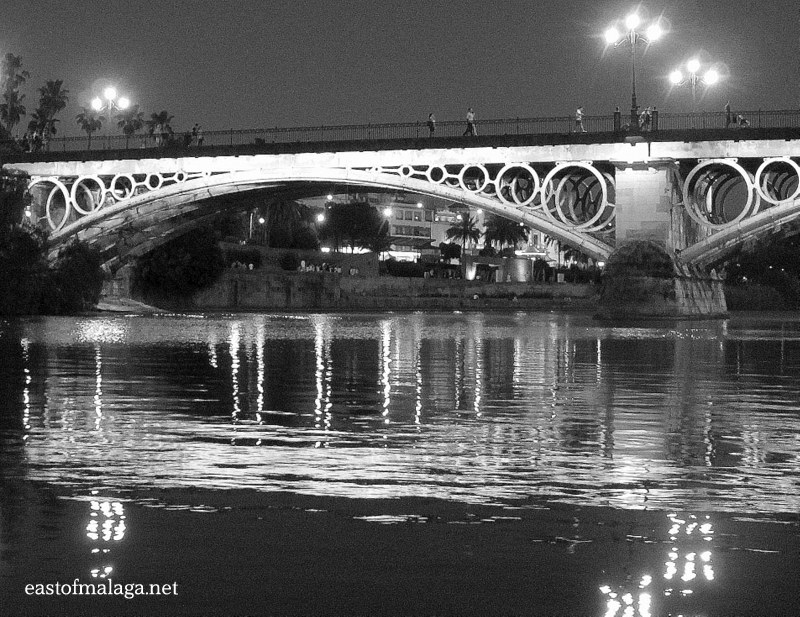
At the stroke of midnight on December 31st 1999 I was standing in Plaza Nueva in the centre of the Andalucían city of Seville with thousands of other people, to welcome in the new millennium.  So, it was with some nostalgia that I returned for a few days recently, to be reminded of the delights that Seville has to offer – both old and new.  I’ll be letting you know all about that in another post coming up soon, but for now, I want to show you the Isabel II bridge, more popularly known as Puente de Triana.

Until 1852, the only way across the Guadalquivir River was by using a makeshift bridge, originally formed in 1171 by chaining 13 boats together between the river banks. In 1847, French engineers Fernando Bernadet and Gustavo Steinacher began work on the Isabel II bridge, linking the Gypsy neighbourhood of Triana with the city centre of Seville.

It’s a pleasant stroll across Triana bridge which has become known for its love-locks, a custom by which padlocks are fixed to a gate, fence or bridge by sweethearts as a symbol of their eternal love.  Because of the numbers involved, this practice has now become frowned upon, and the locks are periodically removed.

As you will gather, I took the above photo whilst enjoying an evening cruise along the Rio Guadalquivir.  I love the way the lights from the bridge are reflected in the gently flowing water.

I also want to take this opportunity to announce the winner of my recent draw to win 6 handwritten postcards from Spain is …… Sylvia of Another Day in Paradise!  

CONGRATULATIONS – I WILL BE SENDING YOUR FIRST POSTCARD VERY SOON 🙂

Related posts:

Black & White Photo Challenge: Bridges

Weekly Photo Challenge: Nostalgic

Travel Theme: Motion

Riddle Me This: The Mysterious Case of the Disappearing Statues

El Vendimiador statue in Plaza Almijara, Competa, Spain

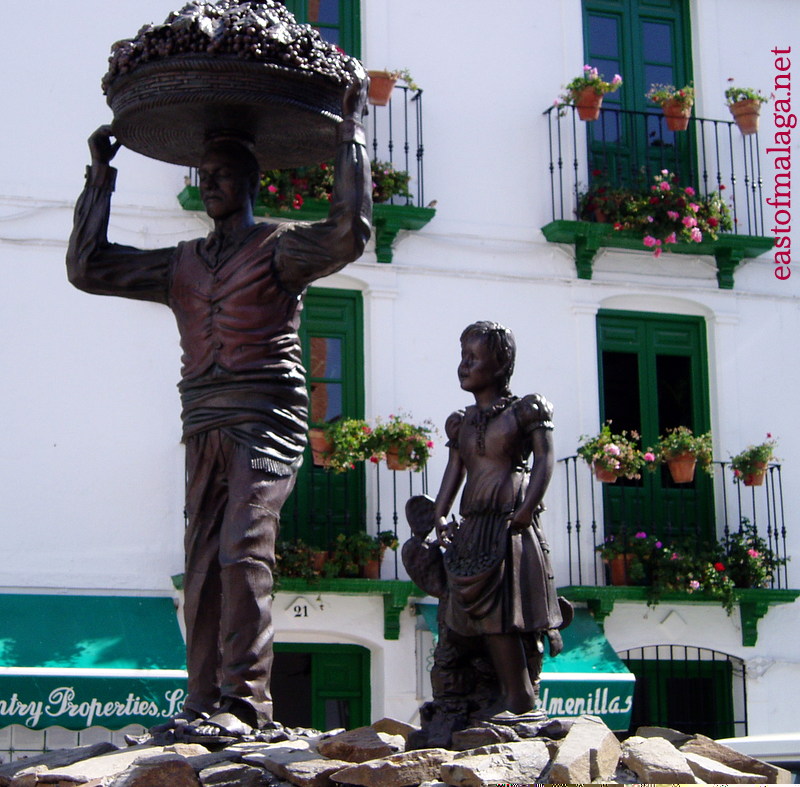
I took this photograph of  the charming El Vendimiador several years ago when it was situated in the main square, Plaza Almijara in the village of Cómpeta.

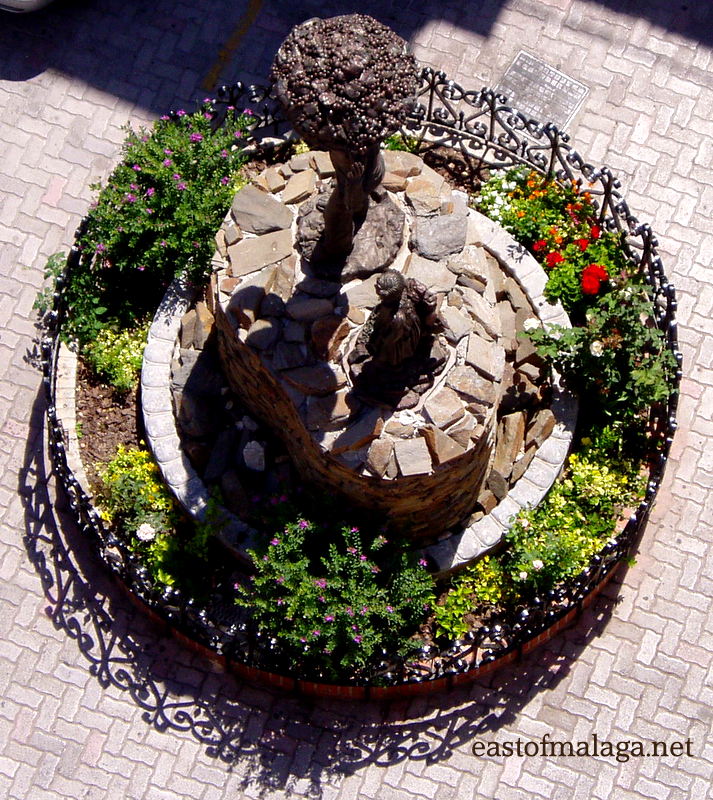
The statue commemorates centuries of wine-making in the area and shows the grape-picker standing in his sandals on a dry-stone wall.  On his head he carries a basket of freshly-picked grapes and by his side, his young daughter helps with the harvest.  

Despite being sited in the main square, next to the 500 year old Iglesia de Nuestra Señora de la Asunción village church only eight years ago, the statue disappeared a few years later.  I suppose this was to make more room for vehicles to turn around in the tiny square, already half full of tables, chairs and sunshades from the nearby cafes and restaurants.

No-one seemed to know what had happened to the statue and some even suggested it had been damaged during the move.

Fortunately El Vendimiador re-appeared earlier this year at the new Mirador in Competa’s Plaza Vendimia (where he really should have been all along), except now he stands alone, without his daughter.  

Curiouser and curiouser …….!

El Vendimiador statue in Plaza Almijara, Competa, Spain (from the church tower)

Looking down on El Vendimiador from the Church tower

This post is my response to this week’s WordPress Photo Challenge: Companionable and to Ailsa’s Travel Theme: Sculpture

You might also enjoy:

Competa´s Noche del vino: Night of wine

The heart of Cómpeta: El Paseo de las Tradiciones

The Day of the Dead: A Celebration of Life

Death in the Afternoon: The Round Cemetery of Sayalonga

I love discovering and exploring burial sites wherever I am in the world, not because of any morbid fascination with death, but in the expectation of visually recording their beauty, history and existence.  To me, cemeteries are places where art, history and world religion meet. 

Of course, visiting the graves of our ancestors is a ritual dating back as long as bodies have been buried, allowing families not only to grieve but also to honour and celebrate lives that have passed. 

In Spain, cemeteries still form an integral part of community life.
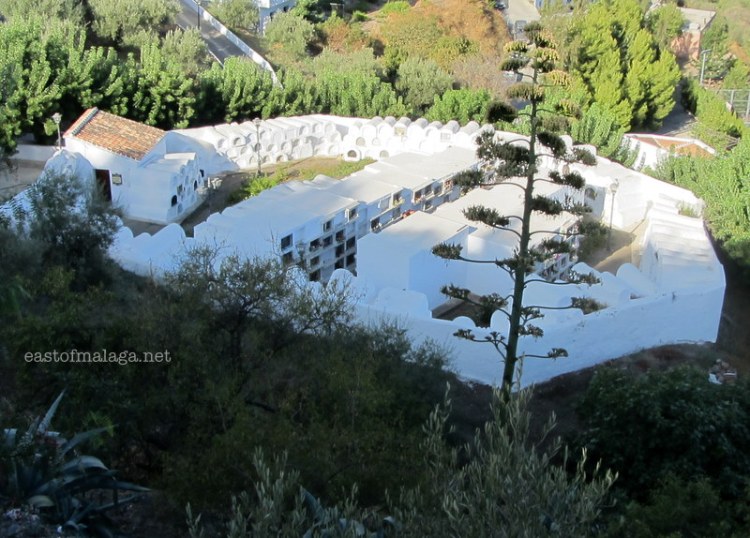
The Round Cemetery, Sayalonga, Spain

The only round cemetery in Spain can be found in Sayalonga, a typical whitewashed village some 40 kilometres east of the city of Málaga and 9 kilometres from the coast, deep in the heart of the Axarquía region.  You might remember Sayalonga from my recent post about the narrowest street in the Axarquía.

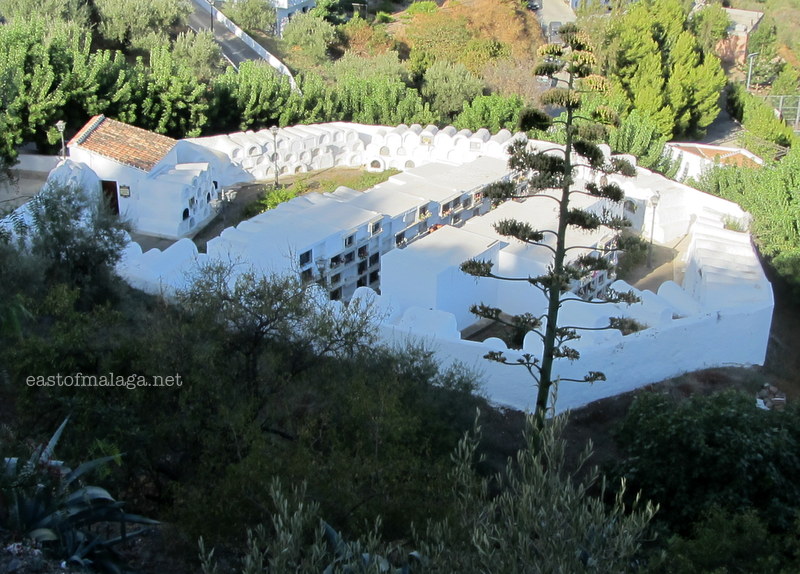
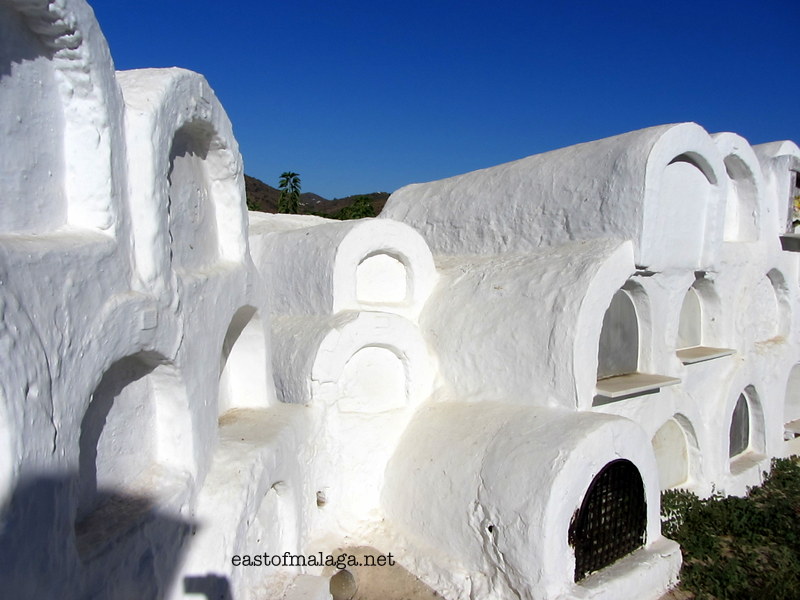
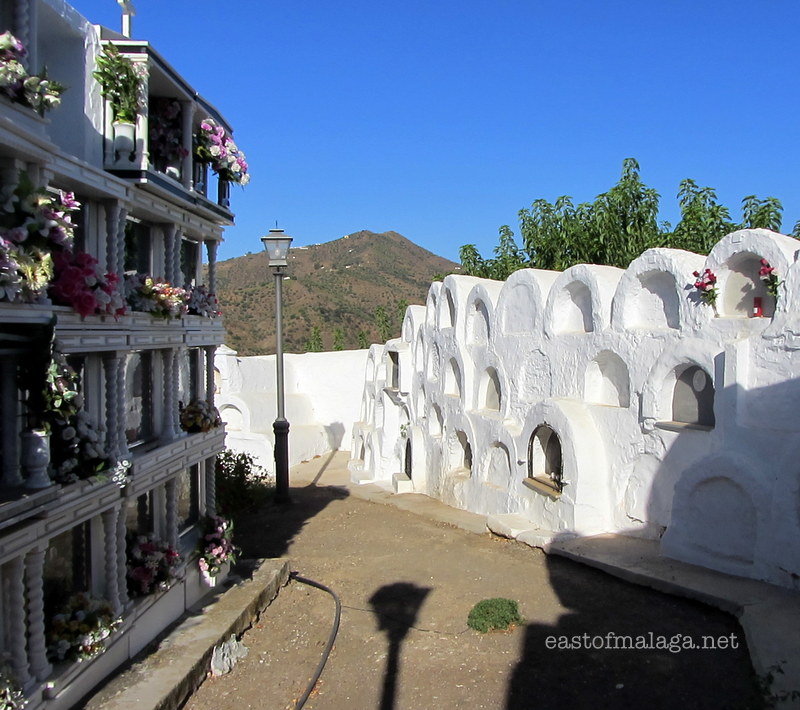
Despite it’s name, the outer walls of Cementerio Redondo, as you can see from the photos, are actually octagonal with rows of parallel, oblong traditional graves added more recently, in the centre.  The older, individual dome-shaped tombs are constructed on top of each other giving the impression of a giant, white honeycomb.
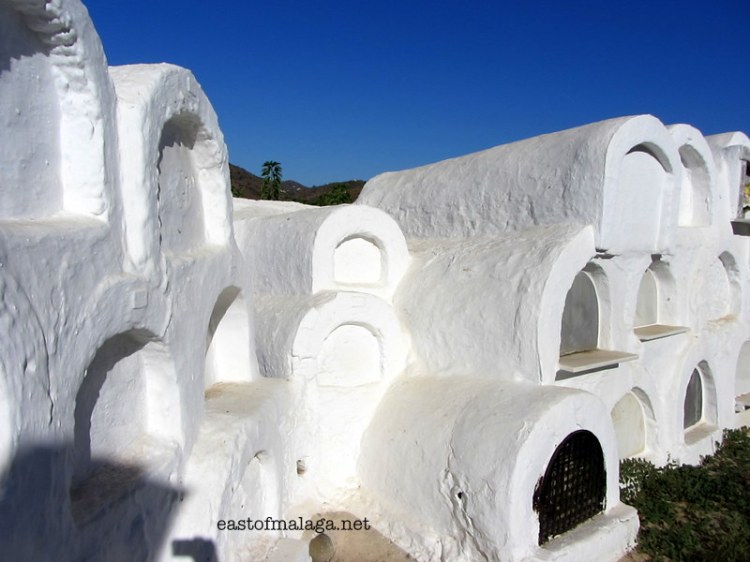
The Round Cemetery, Sayalonga, Spain

Originally, the village cemetery was in the courtyard of the local church of Santa Catalina, however, the Round Cemetery was constructed during the first half of the 19th century and, for hygiene reasons, placed just outside of the village limits.

The motive for this curious shaped cemetery isn’t known, but one explanation is that it was built in imitation of the old cemetery.  I prefer the more romantic interpretation that it was so that the dead could not turn their backs on one another.

There is a small visitor centre at the entrance, which shows and explains the history of the cemetery to more than 3000 tombstone tourists each year.

So, where is Sayalonga’s Cementerio Redondo?

About a forty minute drive east of the city of Málaga along the A7-E15 Autovía del Mediterraneo to km 277, take the exit signposted A 7206 inland towards Algarrobo (pueblo), Sayalonga and Cómpeta.  Stay on the A7206 through the village of Algarrobo and drive up the winding mountain road for a further five minutes until you reach Sayalonga.

There is a mirador (viewpoint) on your left as you are leaving the village heading towards Cómpeta, which gives a good view of the Round Cemetery.

The Round Cemetery, Sayalonga, Spain

Are you a fellow taphophile?  Do you enjoy visiting cemeteries when you are on vacation?  Where’s the most unusual cemetery you’ve ever visited?

Related posts:

Weekly Photo Challenge: Curves

The Day of the Dead: A Celebration of Life

Sayalonga: The narrowest street in the Axarquía

East of Málaga: Flying the Blue Flags

Blue flag beach at Torrox Costa, Spain

At the end of May each year, the independent non-profit organisation Foundation for Environmental Education (FEE) awards its prestigious Blue Flags to beaches and marinas in the northern hemisphere for their water quality, safety standards, environmental education and amenities.

The Blue Flag is a voluntary eco-label awarded to more than 3850 beaches and marinas in 48 countries around the world.    With a total of 648 ensigns, Spain has maintained its position at the top of the list in the northern hemisphere.

Here is the list of current blue flag beaches on the eastern Costa del Sol:  Algarrobo Costa in Algarrobo;  Ferrara in the municipality of Torrox;  Burriana and Torrecilla beaches in Nerja;  Benajarafe  and Torre del Mar in the municipality of Velez-Málaga and last, but not least, Cala del Moral in Rincón de la Victoria

The Blue Flag is awarded on an annual basis, and can only be only held for one season before it will be judged once again by FEE.

Beach, east of Malaga

Related posts:

East of Málaga: The Weather in Summer

La Noche de San Juan: Beaches and Bonfires

Photographs I love – and why