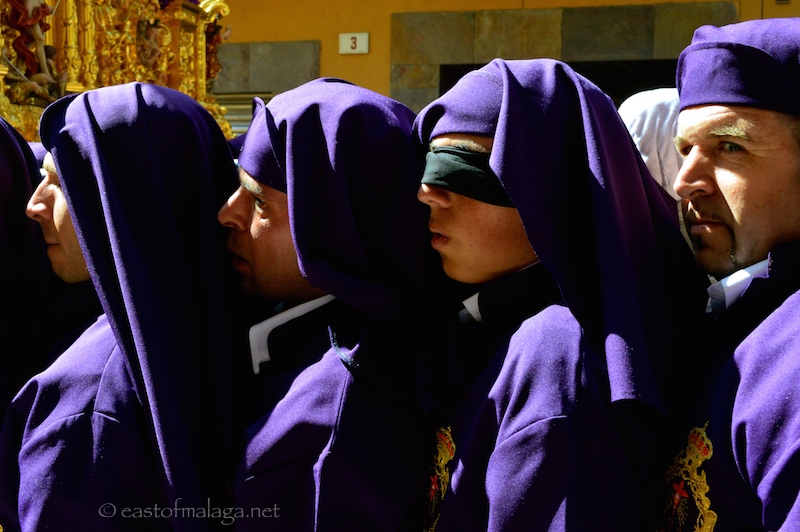
Blindfolded penitent carrying one of the Thrones during Semana Santa, Málaga.
Thought you might like to see some photos I took in Vélez-Málaga on Palm Sunday – the first day of Semana Santa:


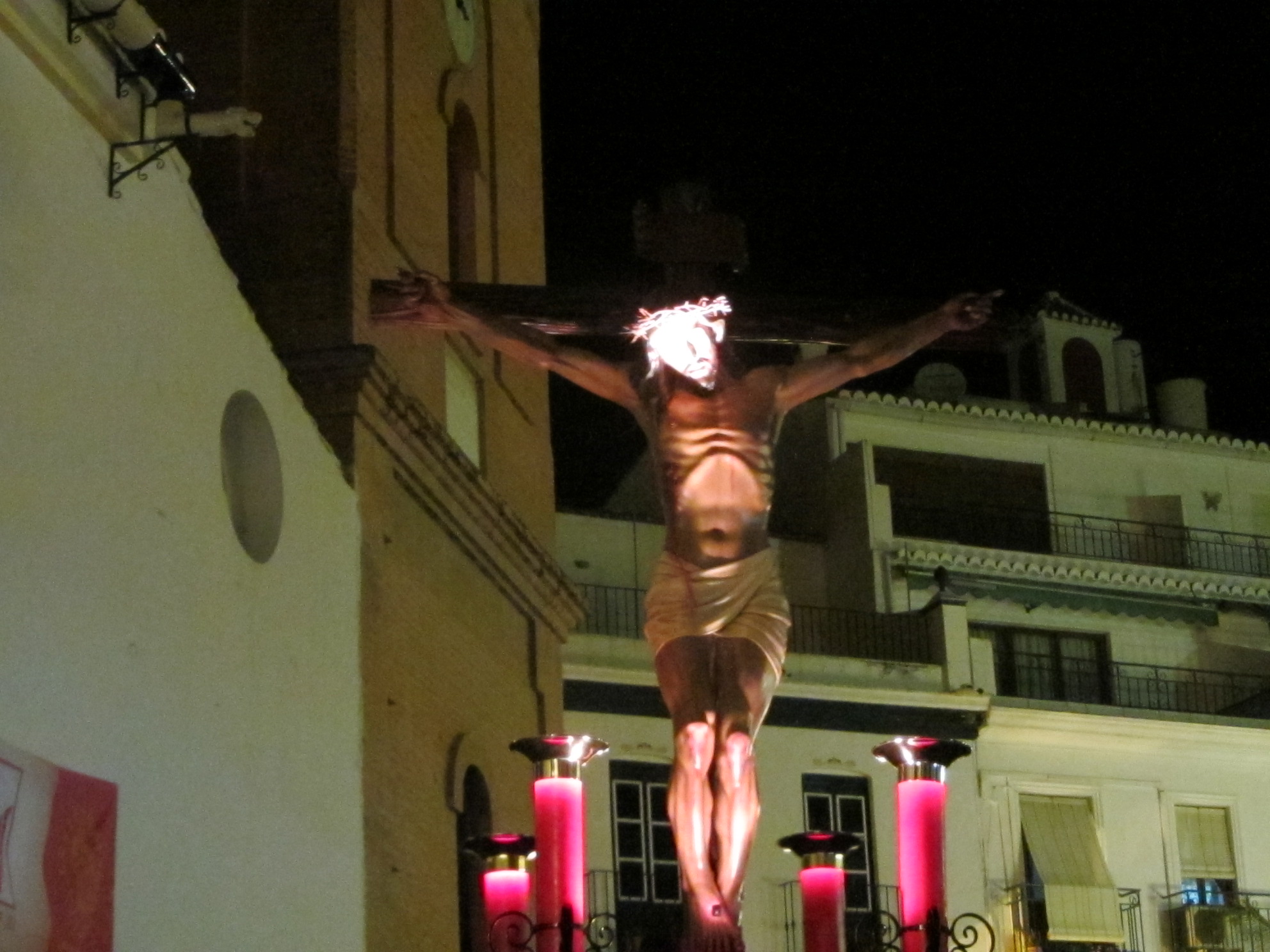
One of the biggest festivals of the year in Spain is upon us – Semana Santa (Holy Week).
Andalucía is well known for the many huge processions taking place each day (and throughout the night), particularly in the cities of Seville and Málaga.
But in even the smallest of white villages throughout La Axarquía, evidence of devotion and penitence can be seen, as religious effigies are squeezed through the often steep, narrow streets.


The images are very powerful as the life-sized religious figures set onto ornate tronos (floats or thrones) sway in time to the slow thud of the drums marking their beat.
The colourfully-robed, hooded penitents of the various Brotherhoods make their way through the streets accompanied by the solemn wail of the trumpets of the local municipal band.
Semana Santa is a festival to be perceived through all the senses.
You can almost taste the overpowering aroma of incense and flowers filling the air as the processions pass by. No matter the time of day or night, villagers will congregate on street corners, steps, or hang over their balconies to see and sometimes applaud or cry out to their favourite tronos, often reaching out to touch the display as it mesmerisingly sways past them.


Make no mistake, you don’t need to be a religious person to be deeply moved or feel the passion of Semana Santa.
After all – THIS IS SPAIN!
EDITED TO ADD: After I posted the video yesterday of the Semana Santa processions in Malaga, I was reminded by Gilly, Cristina and Gemma‘s comments to tell you about the hoods that are worn (some conical and some not). It IS important to know the origin. Thanks ladies 🙂
A common feature of Semana Santa is the Nazareno or penitential robe for some of the participants in the processions.
This garment consists in a tunic, a hood with conical tip (known as a capirote) used to conceal the face of the wearer, and sometimes a cloak. The exact colours and forms of these robes depend on the particular procession.
The robes were widely used in medieval times for penitents, who could demonstrate their penance while still masking their identity.
Sadly, even though these robes and hoods have been used for hundreds of years in this way, they were “hi-jacked” by the Klu Klux Klan in the late 1860s – for which they are more “well-known” outside of Spain.
More’s the pity.
Semana Santa (Holy Week) processions begin throughout Spain, tomorrow. Here’s a taste of what to expect if you are heading to Málaga:
You might have noticed I’ve not been around much for the past couple of weeks. That’s because I’ve been back in the UK visiting family and friends, as well as a six-day trip to Iceland to cross off a “Bucket List” item ….. to see the Northern Lights.
I’m back home in Spain now and I’ll get to see your new blog entries and respond to your kind comments over the next few days.
In keeping with the theme of this blog, and to satisfy my One Trip EVERY Month Challenge, I want to tell you about my recent visit to the Museum of Glass and Crystal in Málaga. I’ve noticed for some time on Trip Advisor that this is Number One rated attraction in the city, so it was time to pay a visit.

We had spent the earlier part of the day at the wonderful Atarazanas food market, enjoying delicious tapas of fresh tuna and prawns at Marisqueria El Yerno, so it was a relatively short stroll towards Plazuela Santisimo Cristo de la Sangre to find the Glass and Crystal museum.
I have to admit that it could have been a bit easier to find, but eventually we arrived after a couple of wrong turns.
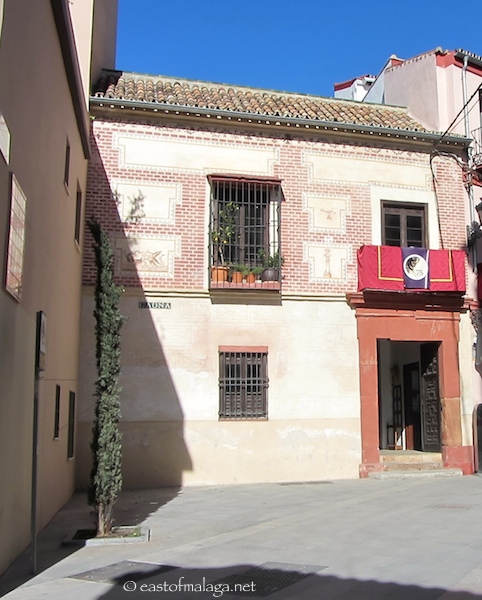
The Museum of Glass and Crystal is privately owned and housed in a beautifully restored 18th century building complete with inner courtyards, and displays a collection of more than 3,000 pieces of mostly European crystal and glass, as well as antique furniture and works of art.


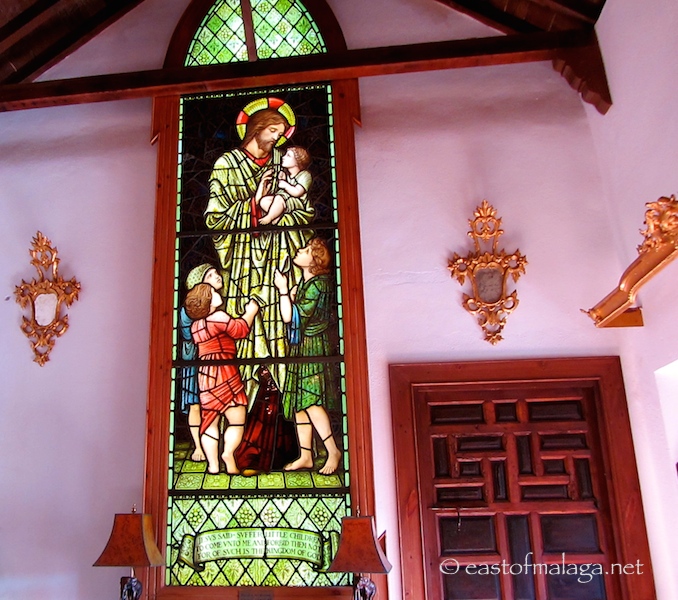
There are a number of stained glass windows from British churches, including a particularly magnificent one by William Morris.
What was particularly enchanting about our visit to this museum was the fact that it is housed within a family home, and we were fortunate to be given a private guided tour by one of the owners, Professor Ian Phillips, whose knowledge and enthusiasm of this unique collection shone through.
My only regret was that we had limited time available for our tour as we had to get back to our parked car, some distance away, before the meter ran out. I look forward to returning to enjoy a more leisurely tour – perhaps when our next visitors are here in the summer.
Collección del Vidrio y Cristal de Málaga
Address: Plazuela Santísimo Cristo de la Sangre 2, Málaga (in front of the main door of the Church of San Felipe Neri)
Telephone: (+34) 95 222 02 71
Opening Hours: Tuesday to Sunday 11am – 7pm. Closed on Mondays, Christmas and New Year’s Days and for the whole of the month of August.
General admission: 5 euros (reduced for certain groups)

This post is my contribution to the One Trip EVERY Month Challenge.
If you’d like to join me, here’s how:
Are you ready to join me by taking ONE TRIP EVERY MONTH? What are you waiting for?
GO!


 East of Málaga