Let’s talk about tapas, shall we?

Well stocked tapas bar in Spain

I’m going to be starting a new feature all about tapas soon, so let’s start by finding about what they are.

It’s thought that originally in the wine-making regions of Andalucia, a cover in the form of a small plate or lid was placed over glasses of wine to keep fruit flies away.  Titbits of food were later placed on the lid to be eaten with the wine.

The word “tapar” in Spanish means “to cover”, which is where we get the word “tapas” from.

How wonderful that Spaniards thought it unacceptable that a fly ends up in your drink, but it´s fine if it lands on the accompanying snack!

Other stories suggest that tapas were invented by a bar owner in Seville, who decided to put a cover (tapa) over his guests´ glasses of wine, using a slice of bread to keep out flies.  He later put a piece of ham or cheese on top, so that his customers could have a bite to eat with their drink.

Rioja and scrummy tapas!

Either way, the idea spread, so that nowadays the types of food served as tapas are limitless.  Most Spaniards don´t drink alcohol without a tapa and many bars, especially in southern Andalucia, provide them free of charge.

The original Spanish “fast food” is usually displayed in refrigerated glass cabinets on the bar and served in small terracotta glazed dishes. Some examples of the type of tapas normally available include gambas (whole cooked prawns in their shells), boquerones (fresh anchovies in olive oil, vinegar and garlic), chorizo (spicy Spanish sausage), albondigas (meatball…often in a creamy almond sauce), queso (cheese…often manchego), habas con jamon (broad beans with ham), ensalada rusa (Russian salad) or just a few olives.

Delicious tapas

Your choice of tapas is usually accompanied by a small piece of crusty bread which helps to counteract the adverse effects of the alcohol through drinking on an empty stomach.

What a sensible idea!

In many establishments, if you stand at the bar along with the locals you will be given one tapa free with each drink you buy.  

That’s right …. free food!

Tapas in Spain

Should you choose to sit away from the bar, you can pay for a tapas or two (usually about one euro in this part of Spain), or opt for a larger serving known as a ración (ration) or medio ración (half ration). This is a great way to eat a variety of dishes, and a pretty sociable activity as groups generally tend to share their dishes.

The food is generally very good, even in remote villages around the Axarquia.

Where is your favourite tapas bar?   Which tapa do you choose, time and time again?


You might also like to look at:

All at sea with the Virgen del Carmen

La Noche de San Juan: Families, fires and football!

Bus Services: East of Málaga

Through the lines and patterns of the Real Alcazar, Seville

Looking through the lines and patterns of the Royal Alcazar in Seville, Spain.

This is my contribution to this week’s Worpress Photo Challenge: Lines and Patterns and the Travel Theme: Through 


East of Málaga: Shall I compare thee to a Summer’s Day in England?

summertime east of malaga

Shall I compare thee to a summer’s day?
Thou art more lovely and more temperate:
Rough winds do shake the darling buds of May,
And summer’s lease hath all too short a date:
Sometime too hot the eye of heaven shines,
And often is his gold complexion dimm’d;
And every fair from fair sometime declines,
By chance or nature’s changing course untrimm’d;
But thy eternal summer shall not fade
Nor lose possession of that fair thou owest;
Nor shall Death brag thou wander’st in his shade,
When in eternal lines to time thou growest:
So long as men can breathe or eyes can see, 
So long lives this, and this gives life to thee.

~ William Shakespeare ~

Most of us are familiar with at least the opening lines of Sonnet 18 by English playwright and poet, William Shakespeare, in which he compares his beloved Fair Youth to that of an English summer’s day.

I’ve suffered endured experienced many cool and rainy summer days in England over the years, when the BBQ I had planned for friends has been a total washout, or no-one could sleep at night because it was too humid, despite being only 17 Celsius.

Of course, it’s not always like that in England but, here in southern Spain, the weather, whilst retaining distinct seasons, is much more reliable.  

The outdoor lifestyle was one of the main influencing factors for our move here, eight years ago.

wandering around the garden

So, what is a summer’s day in July or August like – east of Málaga?

We would typically expect the temperature to be between 30 – 35 Celcius (that’s 86 – 95 Fahrenheit) during the day, with overnight temperatures rarely dropping below 21C (70 degrees Fahrenheit).  Clear blue skies are virtually guaranteed, with little or no rainfall and low humidity.

During August, the thermometer can sometimes touch 40C in the shade, so it’s vital to adapt your lifestyle accordingly.

August days often see me wandering around the house and garden in a swim suit and loose-fitting sarong, with my hair tied up, wearing no make-up. Carefree. And, because we live in the countryside a few kilometres from the coast,  days often go by without seeing another souland that suits me just fine. my office for today Not only do many northern European tourists head down this way for their annual vacation, but the rest of the population of Spain seems to end up around these parts, too.  So, we tend to stay at home, out of the way of the crowded restaurants and the lack of parking spaces, only venturing out when we need to buy groceries or if we choose to stroll along the promenade on a Saturday evening, before visiting a local chiringuito (fish restaurant).

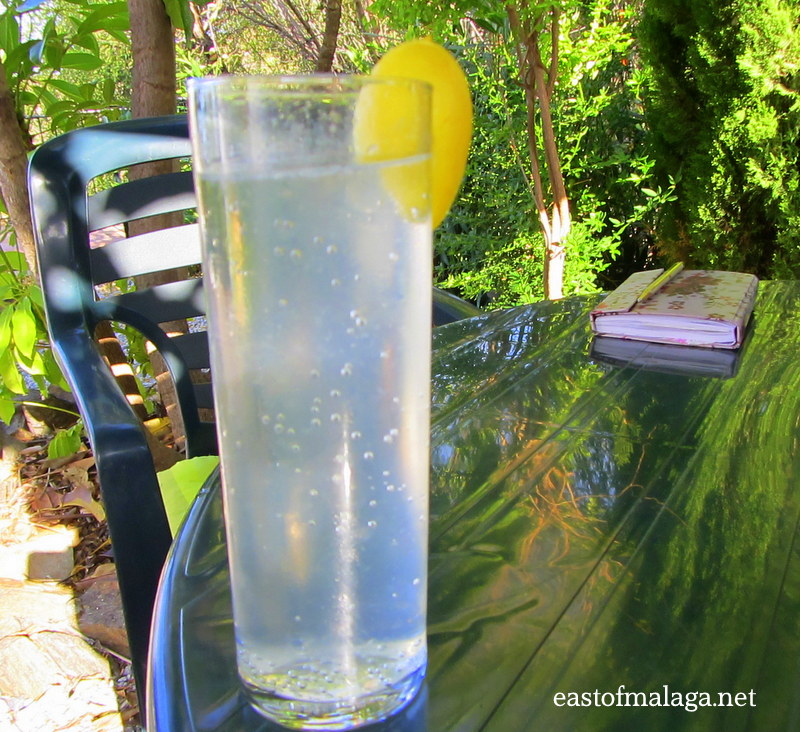
I’m an early riser, so the first thing I do when I get out of bed is to throw all the windows and doors open, allowing the cool morning air into the house.  Any chores that need doing are always completed well before 11am, by which time, the windows are closed to keep the warm air out. As the sun continues it’s journey around the house, various blinds are pulled down over the windows to stop the heat from penetrating. Sparkling water with fresh limequat My days are spent writing, wandering nearby taking photographs, sipping cool drinks, trying to catch up with my list of books to be read, or simply taking a dip in the pool when I get a bit overheated.

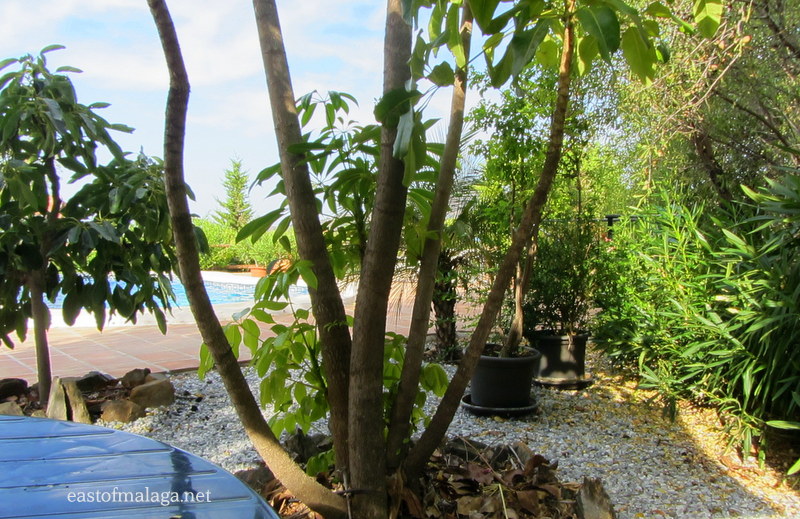
We have several cool, shady terraces where I choose to to locate my “office” for the morning.   Today’s lunch will be fillet of salmon with patatas a lo pobre, prepared earlier this morning, and made all the tastier knowing that the onions and green peppers have been grown in our vegetable patch.  I’m pretty sure that we’ll have a chilled glass of wine with lunch, too. 🙂

This afternoon, there could be a siesta, another swim or time to catch up reading blogs I enjoy.   I might even plan more of our next trip (to Portugal in October) or chat to friends around the world on the internet.

After sunset, the windows are once again thrown open, and it’s a delight to feel the cool evening air, as the delicious perfume of the night-scented jasmine pervades the surroundings.

One thing I love about hot, summer nights is the chance to have a swim after dark before hopping into bed.  I always make sure that there are no outside lights shining from the house and, because we live in the countryside, there is virtually no light pollution.  It´s quite surreal floating about in the pool on your back on an airbed watching the stars twinkling overhead. Sleep comes easily after such a carefree day, with the open window and overhead ceiling fan keeping me cool.

So, east of Málaga, shall I compare thee to a summer’s day in England?  NO, I’ll just enjoy every day spent in this beautiful country I have adopted as my home, and take English summers as, and when, I choose to find them.

You might enjoy these summer related articles, too:

Phew – what a scorcher!

Flying the Blue Flags on the beaches

Hummamole Dip – perfect for a summer’s day

Should Seville’s barefoot nuns have faith in my cake-baking skills?

Just out of the oven

When I was in New Zealand earlier this year, I stayed with a lovely lady called Val, who introduced me to Herman the German Friendship cake.  Val was only part way through the 10-day cycle of making the cake, so I wasn’t able to join in with the fun.  Besides which, I was travelling at the time, so it wasn’t very convenient.

Herman the German is a sourdough cake, often received from a friend as a “starter mix” and which sits on your kitchen counter for ten days, bubbling away, covered with a tea towel.  Along with your starter mix, you also receive written instructions on how to proceed.  On the tenth day, you divide the mixture to share with your friends, and bake your cake.

To be honest, since returning home to Spain from New Zealand, I’d forgotten all about Herman.

A few weeks ago, Sue, a FB friend and fellow expat blogger from Extremadura in Spain, asked if anyone was interested in sharing some of her starter dough for Herman’s Spanish equivalent: Bizcocho de las Carmelitas Descalzas de Sevilla (The Barefoot Carmelite nuns of Seville cake).  I should imagine you were wondering where the nuns came into it!

Anyway, how could I refuse?

All we had to figure out now was how she would get the starter mix to me when we live about 500 kilometres apart!

Fate stepped in – in the form of The Open-Air Theatre Project, a small, rural community from the Alpujarra mountains in southern Spain with their dream of building an open-air theatre.  To cut a long story short, Sue was on her way to meet up with the group, and she kindly diverted from her route to deliver my starter cake-mix, together with a sheet of instructions in Spanish (of course).

She also brought me five jars of the most delicious home-made plum, cherry, fig and loquat jam.  YUMMY!

How lucky am I?

As soon as I got home from meeting Sue, I tipped the bubbling dough mix into a large pot bowl, covered it with a tea towel and, over the next ten days, followed the written instructions to the letter – sometimes adding ingredients, often doing nothing.

Today is the tenth day – so, this morning I set about dividing the mixture into four, in order to be able to give away three “starter mix” portions to friends and neighbours, added the extra ingredients and made my cake!

If you want to have a try yourself, you can get the recipe for Herman the German cake by CLICKING HERE.  Don’t worry if you don’t have any friends anyone to give you the starter mix.  You can always start the cake off, yourself, but I really liked the idea of the sharing bit.  If you live near me and would like one of my starter kits, let me know!

Herman’s Spanish sister cake can be found by Googling “Bizcocho de las Carmelitas Descalzas de Sevilla”, choose one of the links and click on “translate this page” and Bob’s your Uncle – so to speak!

MY TOP TIP: After cooking for 45 minutes, take the cake out of the oven, cover with foil to prevent the top from burning, and pop back into the oven for a further 15 – 20 minutes to make sure the middle is cooked well enough.

So – should Seville’s barefoot nuns have faith in my cake-baking skills?  

I think so – but I’d love to know what you think!