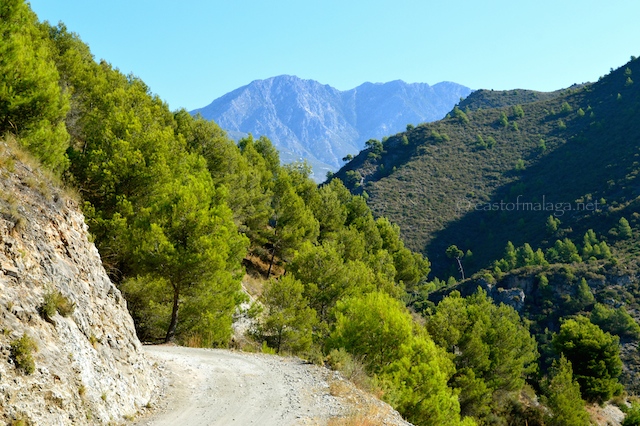
The spectacular U-shaped Zafarraya Pass (El Boquete de Zafarraya) which marks the boundary between the provinces of Málaga and Granada can be seen for miles around. Standing impressively over 900 metres above sea level, the Pass has been used for centuries as a key route through the sierras, linking lands south-west of Granada, with the towns and villages along the coast, east of Málaga.
Although I have made the journey through the Pass many times, I never fail to be impressed by this ancient route through a huge cleft in the mountain spine of the Sierra de Alhama.
The name Zafarraya may have come from the Arab Fahs al-raiyya meaning “field of shepherds”, although there are people who think it derives from Saiarraya, meaning “territory limit”, referring to the fact that at one time Zafarraya belonged to the province of Málaga.
To get there, we drove north from the A7/E15 Autovía del Mediterraneo, past the town of Vélez-Málaga and briefly alongside Lake Vinuela, before heading up the A402, a winding mountain road towards the Pass.
Along the way we stopped at the ruins of Zalía castle (castillo de Zalía) which sits on a hill opposite the white Andalucían village of Alcaucín. It is thought that the Phoenicians established the foundations of the fortress, but the castle was later built by the Moors around the 10th century to guard the ancient Nasrid Route through the Zafarraya Pass from Granada to Málaga.
Even though many of the wildflowers I have told you about over recent weeks have now started to die back near to where I live, they are still flourishing in abundance further inland, so we stopped many times to take in the natural beauty as well as many photographs.
In 1979, a cave was discovered near to the Zafarraya Pass (Cueva del Boquete de Zafarraya), with a subsequent archaeological dig unearthing the best preserved remains of Neanderthal man (radiometrically dating back 30000 years) ever found in Western Europe.
Importantly, the find was one of the first pieces of definite evidence showing that Neanderthals co-existed with modern humans for almost 10,000 years, disproving earlier theories that they had been quickly replaced by modern man.
Image from: Museo de Málaga
As we approached the gap in the mountains, the entrance to a small tunnel through the rock can be seen, which was once part of the former Periana to Zafarraya railway line, abandoned fifty years ago. The tunnel is now used by walkers who enjoy strolling along the former railway line, which is now a dirt road.
Tunnel image found here
The old railway bridge across the road as you drive through the Zafarraya Pass is a more obvious relic of the old railway line.
It is here that you can find the village of Ventas de Zafarraya, so named because in times long past, travellers would stop for food and shelter at one of the local inns (ventas), where they could also exchange and refresh their weary horses and oxen, before continuing on their long journeys.
These days, Ventas de Zafarraya is almost entirely dedicated to vegetable growing on the fertile, flat land just beyond the village, where many different vegetables including lettuces, artichokes and beans are grown up rustic canes cut from nearby river banks.
Many of them are not much bigger than my little veggie plot at home!
Related articles:
Classic Andalucía: La Alhambra, Granada
Wildflowers of Andalucía: Dutchman’s Pipe
The Green, Green Vegetables of Home
I often have a little chuckle to myself when I am shopping in a Spanish supermarket.
Seriously, would YOU buy some of these products?
Nelly hairspray
Bimbo bread
Now, call me fussy, but I can’t bring myself to wash my clothes in Colon Vanish washing detergent!
or (possibly) even worse, Flota Spa washing powder!
But, being a northern lass (originally from Lancashire in England), I always find some consolation knowing that at least I can always find Somat f’ert dishwasher! LOL
Have you spotted any products in other countries that sound strange or amusing in your own language? You will let me know, won’t you? LET’S HAVE SOME FUN!
Other posts you might enjoy:
Roadside Advertising: Not just a Load of Bull
Classic Andalucía: La Alhambra, Granada
Click any image to open a slide show
Even though I always wear gloves for gardening, my hands were still left a bit grubby after preparing the vegetable plot last week, as I still insist on poking around in the soil even when I’ve taken them off! So I decided to make a very simple salt scrub and my hands were soon good-as-new. Want to know how I made it? Here’s how:
I wanted to only use ingredients I have at home, without going out to buy anything – besides which, I needed to use the salt scrub in quick-style! I used 1 cup of sea salt, 1/2 cup of baby oil, the zest of two lemons and a couple of sprigs of rosemary from the garden.
First of all, I put the sea salt into a bowl, added the baby oil and gave it a little stir. Then I zested two lemons, pulled the individual rosemary leaves from the sprigs and chopped them roughly. All that was left was to tip the lemon zest and rosemary into the mixture, give it a final stir and spoon into a pretty jar .
I then added a label and tied something pretty around the outside of the jar and that’s it – done!
Easy peasy lemon squeezy ….. so to speak!
What rewards do you treat yourself with for a job well done?
You might also enjoy:
Easy No-Bake Chocolate, Peanut Butter and Oatmeal Cookies
Fresh Figs Stuffed with Goat´s Cheese and wrapped in Smoked Bacon
I can see Africa from my terrace!
Click any image to open a slide show
I’ve mentioned before that we don’t live in a town, city or even a small village. We live in the open countryside (known locally as el campo), so our garden isn’t the kind of cultivated area we used to have back in England. Our house was built onto a hill-side of almond trees and indeed, when we moved here almost eight years ago, the only things that were already planted (apart from the naturally-placed wildflowers) were 47 established almond trees, on almost an acre of land. Of course, the area immediately around the house, car park, swimming pool and terraces is flat but the rest of our land is sloped, and we have chosen to leave a more “natural” look further away from the house, to blend in with the surrounding countryside.
As time as gone by we have added many more trees, shrubs and bushes and I have previously posted photographs of lemons, apple blossom, bird of paradise flowers, figs, oranges and some of the many beautiful wildflowers at present gracing the garden.
Despite the apparent poor quality of the soil, the valley where we live is extremely green with trees and vines growing down the hillside. Newly planted trees need care for the first year or two, but once established seem to thrive, provided they are given sufficient irrigation.
The nature of the ground is generally sloping, rough and rocky with poor, shallow soil over bedrock. Untended ground is usually very hard (with need for a pick-axe to dig holes for planting) allowing deluges of rain little chance to penetrate the soil, thereby creating deep channels where the water has run off .
However, it’s not all bad news as there are patches of slightly deeper soil here and there, and it’s one of these that last week we decided to transform into a small vegetable patch.
We were able to buy some little plug plants in Vélez-Málaga, at a total cost of just over 11 euros and, after quite a bit of digging, raking and throwing out stones, we finally got to plant red, green and hot peppers, chard, squash, green beans, red and green lettuce, red onions, fennel and melons.
After three days, I can report that the little plants appear to be doing well. I’ll keep you posted on their progress!
Previous posts you might find interesting:
A Slice of Life: Garden and Plant Irrigation
Flowering snapshot of a January day around the garden
Wildflowers of Andalucía: Dutchman’s Pipe
View of the Alhambra from the Mirador de San Nicolás in the Albayzin of Granada.
The Alhambra, a UNESCO World Heritage site is a palace and fortress complex located in the classical Andalucían city of Granada, Spain. It was originally constructed as a fortress in the year 889 and later converted into a royal palace in 1333 by Yusuf I, Sultan of Granada.
La Alhambra’s Islamic palaces were built for the last Muslim emirs in Spain and its court of the Nasrid dynasty. After the Reconquest by the Catholic Monarchs in 1492, some portions were used by Christian rulers. The Palace of Charles V, built by Charles V, Holy Roman Emperor in 1527, was inserted in the Alhambra within the Nasrid fortifications.
After being allowed to fall into disrepair for centuries, the Alhambra* was rediscovered in the 19th century by European scholars and travellers, when restorations commenced.
It is now one of Spain’s major tourist attractions, exhibiting the country’s most significant and well known Arab-Islamic architecture.
The Palace of Charles V – within the Alhambra, as viewed from the Mirador de San Nicolás in the Albayzin of Granada.
View of the Alhambra from the Mirador de San Nicolás in the Albayzin of Granada.
My final three shots were taken on Monday afternoon as we were having lunch in one of the wisteria-covered restaurants in Paseo de los Tristes. Perched above the Rio Darro at the end of Carrera del Darro, this plaza was once one of the busiest gathering spots in Granada, positioned along a curve of the river between the Alhambra and the Albayzin. These days, Paseo de los Tristes is a popular place to eat, with restaurants lining the north side of the square and magnificent views of the Alhambra soaring above.
View of the Alhambra from the Paseo de Los Tristes, Granada.
View of the Alhambra through the Wisteria, from the Paseo de Los Tristes, Granada.
View of La Alhambra viewed through my particularly delicious glass of Rioja, as I was having lunch – CHEERS!
* Information about the Alhambra retrieved from Wikipedia
Related posts:
Ubirr Rock, Northern Territory
When I was wandering in the garden the other day, I noticed these gorgeous wildflowers growing in the shade of some of the almond trees. Strangely enough, there is just this one patch of them, and I’ve never noticed them before! They are a purple/brown colour (some with a yellow/beige interior), have heart shaped leaves, and are a climber/vine.
I looked in my flower book, but couldn’t identify them, so I posted a photo onto Facebook and sure enough, someone knew what they were - Aristolochia baetica.
According to Wikipedia they belong to the Aristolochia/birthwort family, with their common names “Dutchman’s pipe” and “pipevine” being an allusion to old-fashioned meerschaum pipes at one time common in the Netherlands and Northern Germany.
“Birthwort” (e.g. European birthwort A. clematitis) refers to these species’ flower shape, resembling a birth canal.
I think they look like a bird’s nest full of baby birds with their beaks open, waiting to be fed! What do YOU think?
You might also enjoy:
Wildflowers of Andalucía: Bloomin´ lovely!
A Slice of Life: Garden and Plant Irrigation
CBBH Photo Challenge: KNOBS AND KNOCKERS
Forget bells and intercoms – this month’s CBBH Photo Challenge is all about decorative door furniture, to make an entrance look perfect.
Of course, the purpose of a door knocker is to let the householder know there is someone at the door, but at some point in history they took on shape and symbolic meaning. I’ve seen protective dogs and lions, honorary wreaths, severed hands, mythological references to Medusa and Cleopatra, as well as elegant and ornate displays of wealth in polished brass.
There are some really interesting knobs and knockers out there, just waiting to be discovered and photographed. CAN’T WAIT TO SEE YOURS!
SPOILER: SCROLL DOWN FOR DETAILS OF HOW TO GET MY $25 THANK YOU GIFT – FOR EACH ONE OF YOU!
I photographed this beauty in the Spanish city of Toledo, at the end of last summer. Isn’t it amazing?!
Used frequently as door knockers, another vestige of the Moorish occupation of the Iberian Peninsula is the Hand of Fatima. Fatima Zahra was the daughter of the Prophet Mohammed, and the hand door knockers are talismans used to ward off the evil eye, and offer protection to the household.
This may not be a photo of a fancy door knob, but it is a significant one. Around many of the little villages in Andalucía there is often a morning bread delivery. The little van from the panaderia winds its way around the steep streets, leaving a loaf of bread tied to the doors of many of the houses, in much the same way that the milkman used to make his early morning deliveries to make sure you had your daily pint of milk, back in the UK. Does that still happen I wonder?
So, there you have them – some grand knockers on plain doors, some quite plain knobs and knockers on grand doors.
** The Legion of Door Whores has a collaboration of contributors who post doors of many descriptions they have photographed. Considering the theme of this month’s challenge, l was delighted to find a particularly splendid pair of door knobs in Girona, Spain as well as these fine brass knobs in Buenos Aires, along with a host of other doors in all shapes, sizes and condition. If you are a bit of a Door Whore yourself, you will be amazed at some of the beautiful photographs posted onto this blog.
** Kiva is a non-profit organization close to my own heart, with a mission to connect people through lending, to alleviate poverty. Leveraging the internet and a worldwide network of microfinance institutions, Kiva lets individuals lend as little as $25 to help create opportunity around the world. Learn more about how it works.
Kiva gives you the chance to make small loans to borrowers working to start businesses and improve their lives. I’m already a Kiva lender and as a way of saying thank you for your support of my blog, I WOULD LIKE TO OFFER YOU A $25 FREE TRIAL.
To redeem your Free Trial all you have to do is CLICK THIS LINK and choose who to lend your money to – BUT HURRY – THERE IS A LIMITED NUMBER OF FREE TRIALS. IT WON’T COST YOU A PENNY – I PROMISE! Kiva will notify me if any of my readers take up a Free Trial, but I’d love you to still let me know in the Comment section, below.
TOGETHER, LET’S TRY TO MAKE A DIFFERENCE THIS MONTH!
So that´s the CBBH Photo Challenge for MAY, everyone!
Remember, all you have to do is post your entry by the end of the month, tag your entry ‘CBBH Photo Challenge’, link back to this blog and, most importantly, don´t forget to add links to any two blogs that you´ve commented on during the past month, so that we can all HOP OVER and have a look. Make sure you FOLLOW THIS BLOG so you don´t miss next month´s exciting challenge!
For more information on how the CBBH Photo Challenge works click here.
I hope everyone taking part enjoys the exposure the CBBH Photo Challenge offers to featured blogs and, who knows, you may end up finding a new favourite! I´m looking forward to seeing your interpretations.
[CBBH logo Image credit: (cc) Mostly Dans]
This is the lovely view across the bay at La Herradura (which is the Spanish word for horseshoe).
Don’t forget, there are only two days left to get your entries in for this month’s CBBH Photo Challenge: MULTI-COLOURED. New challenge starts on Wednesday!

Blog at WordPress.com. Theme: Nishita by Brajeshwar.