


The Bird of Paradise is in flower, right now

According to leading English newspaper The Guardian‘s international panel of experts, and based on a combination of current form and overall ability,
Each judge on the panel was asked one simple question: “Who have been the 40 best players in the world in 2013?” When the results were collated, the newspaper produced their list of the 100 best footballers in the world.
 Image credit (Flickr CC): Rafael Amado Deras
Here then, according to that list, are the ten best footballers in Spain today:
1. Lionel Messi (Barcelona)
2. Cristiano Ronaldo (Real Madrid)
3. Andres Iniesta (Barcelona)
4. Neymar (Neymar da Silva Santos Júnior) (Barcelona)
5. Gareth Bale (Real Madrid)
6. Xavi (Xavier Hernández Creus) (Barcelona)
7* Sergio Busquets (Barcelona)
8. Cesc Fabregas (Barcelona)
9. Diego Costa (Atlético Madrid)
10. Xabi Alonso (Real Madrid)
* Radamel Falcao (formerly of Atlético Madrid) was on the list at #7, but transferred to Monaco in mid-2013, so the players below him move up one place.
Even better news is that you can see some or all of these great players during your next trip to the AUTHENTIC Costa del Sol by timing your visit with a home fixture at Málaga football club.
You won´t have long to wait either, as Málaga’s La Liga 2013/2014 season continues this coming Saturday 15th March at 5pm with a home match at Estadio La Rosaleda against Real Madrid.
All the time I was searching out my choice of photographs for this month’s CBBH Challenge, a song kept running through my head:
Raindrops on roses and whiskers on kittens
Bright copper kettles and warm woolen mittens
Brown paper packages tied up with strings
These are a few of my favourite things
….and the more I thought about it, the more I realised it’s true – I do love to see raindrops on flowers after the rain.
But extremes of weather often make the TV news, and the UK in particular has been battered by storms and flooding over the past months, so your interpretation of AFTER THE RAIN might be very different from mine – and that’s where the fun begins.
For the CBBH Photo Challenge during March I want you to post images of your experience, AFTER THE RAIN.
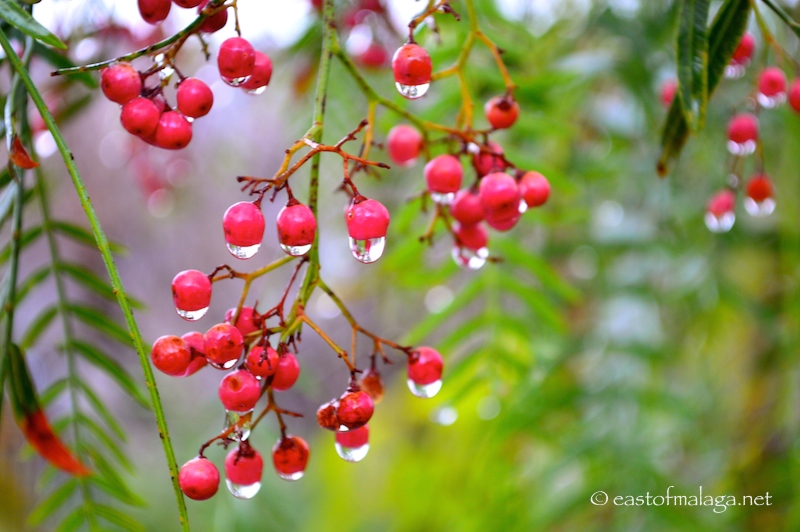
This is the graceful False Pepper tree (Latin Name: Schinus molle) in my garden, with its clusters of pink peppercorns. I’ve think I’ve read somewhere that the peppercorns are edible in moderation, but I’ve never been brave enough to try them.
Besides, they look great, just where they are …. especially after the rain, when the raindrops clinging to them are of similar size.

I’m a huge fan of the colour purple, so this plant is a favourite, too, but until this morning I didn’t know what it was called. Thanks to the power of the internet, and my lovely readers, Trish and Maggie I can now tell you that this is Hardenbergia comptoniana, a native of Australia. This vigorous climbing plant has scrambled along a rocky ledge and entwined itself in one of the almond trees on the bank above the house. Thanks for putting me out of my misery, ladies 🙂
I love the elegant arching purple flowers, which are even more beautiful after the rain.

My final photo for this month’s challenge is of the raindrops clinging to one of the fruits on the lemon tree. I never fail to be delighted at being able to nip outside, at almost any time of year, and pluck a fragrant lemon from the tree.
So now it’s YOUR turn.
Don’t forget that the CBBH Photo Challenge is a little different from some other challenges, in two ways. First, it’s only once a month – giving you lots of time to consider your entry before the end of the calendar month. Second, and most important, this is a BLOG HOP (after all, it is the CBBH – Conejo Blanco Blog Hop, conejo blanco means white rabbit in Spanish), so DON’T FORGET that in your post you need to add links to two blogs that you have visited and commented on during the past month. That way, when we visit each other, we can HOP OVER to your links, connect with others and share a little blog love around!

*** Hola Yessica follows the adventures of Jessica who grew up in California, but now lives in beautiful Barcelona. If you’re looking to discover the very best of what the Catalan capital has to offer, then Jessica’s your girl! Her new video series, “My Barcelona” includes insights as to why football really is a religious experience in Barcelona and explores the fabulous street art around the city.
*** The best way to appreciate the culture of any area is through its food and its wine. And nowhere is that truer than in Annie B’s Spanish Kitchen. Annie shares the delights of living in Vejer de la Frontera in southern Spain, and offers Spanish recipes and cooking tips. You’ll love her easy chocolate and almond cake or, if you are looking for a delicious Moroccan dish, then try Annie’s Chickpea, Orange and Mint salad. Mmmmm …. delicious!
So that´s the CBBH Photo Challenge for March, folks.
Remember, all you have to do is post your entry by the end of the month, tag your entry ‘CBBH Photo Challenge’, link back to this blog and, most importantly, don´t forget to add links to any two blogs that you´ve commented on during the past month, so that we can all HOP OVER and have a look. Make sure you FOLLOW THIS BLOG so you don´t miss next month’s exciting challenge!
For more information on how the CBBH Photo Challenge works click here.
I hope everyone taking part enjoys the exposure the CBBH Photo Challenge offers to featured blogs and, who knows, you may end up finding a new favourite! I´m looking forward to seeing your interpretations.
[CBBH logo Image credit: (cc) Mostly Dans]

EDITED TO ADD: My most up-to date COST OF LIVING report for JULY 2015 can be found HERE.
Every day, around one hundred people find themselves visiting my blog after typing the search term “Cost of Living in Spain” into Google. It’s a popular subject, and for that reason each year I publish a list of the current prices of a number of items here in southern Spain.
It’s worth bearing in mind that the following information is relevant to the kind of lifestyle and area where I live, east of Málaga. We choose to live like locals, eating fresh, seasonal produce and frequenting bars full of Spaniards rather than tourists. Similarly, if your choice would be to only buy internationally branded foods and eat in tourist areas then you will find costs are considerably higher.
So …. whether you are fed up of the wet weather in the UK, have been dreaming of living in southern Europe for many years or you’re just curious – here’s my updated list of standard grocery items for your perusal.
For the sake of comparison, I have once again used the largest Spanish supermarket – Mercadona.

STANDARD GROCERY LIST
This is the up-to-date Standard Grocery List I have published previously. The first price shown is as it was in August 2013, with this month’s prices in RED alongside.
Milk (semi–skimmed UHT, own brand), 1 litre 0.59 € 0.60 €
Loaf (white, baguette 250g) 0.45 € 0.45 €
Loaf (white, Bimbo brand, 460g 100% natural) 1.49€ 1.49 €
Butter (250g, own brand) 1.05 € 1.25 €
Sugar (1kg, white) 0.93 € 0.93 €
Coffee (ground, 250g, Santa Cristina) 1.89 € 1.89 €
Eggs (12, own brand caged, medium) 1.35 € 1.35 €
Olive oil (1 litre, extra virgin, own brand) 3.35€ (5 litres 15.50€) 3 € (5 litres 14.50 €) **
Rice (1kg, long grain, own brand) 0.71€ 0.71 €
Pasta (1kg, own brand) 0.79€ 0.75 €
Pasta (500g, wholewheat) 0.99€ 0.99 €
Tinned tuna (6 x 80g, own brand) 3.39€ 3.35 €
Chicken breasts (1kg, boneless, skinless, packaged)) 5.80 € 5.80 €
Pork chops (1kg) 4.60€ 4.75 €
Beef mince (Store brand, pre-packed, 700g) 3.80 € 3.80 €
Fish (1kg Salmon steaks) 10.75 € 10.75 €
Fish (1kg Dorada, Gilt-head bream) 6.95€ 6.95 €
Apples (1kg, green, Golden Delicious) 2.00 € 1.85 € **
Oranges (1kg) 1.19 € 0.79 € **
Bananas (1kg) 1.29 € 1.39 €
Potatoes (1kg) 1.25 € 0.89 € **
Lettuce (1 head, Iceberg) 0.85 € 0.87 €
Red Peppers (1kg, loose) 1.95 € 1.89 €
Green pointed “Italian” Peppers (1kg, loose) 1.35 € 1.99 € **
Tomatoes (1kg, loose) 0.99 € 1.29 € **
Coca-Cola (1.5 litre bottle) 1.09 € 1.09 €
Water (2 litre bottle) 0.42 € 0.42 €
Domestic Beer (1 litre bottle, Cruzcampo) 1.25 € 1.25 €
Imported beer (6 x 25cl bottles Heineken) 3.05€ 3.65 €
Bottle wine (medium priced) 3.00 – 3.50€ 3.00 – 3.50 €
Colgate toothpaste (100 ml) 1.75€ 1.75 €
Pantene shampoo (300 ml) 3.00€ 3.00€
Toilet rolls (pack of 6, own brand) 1.95 € 1.98 €
Washing powder (Box, 35 washes, Elena brand) 4.87 € 4.87 €
** Seasonal changes
For the costs of accommodation, utilities, motoring, public transport and entertainment – prices are largely unchanged since last time. Please see HERE.

Many people dream of moving to southern Spain with the promise of better weather coupled with a healthier, outdoor Mediterranean lifestyle. There are many other considerations to bear in mind when trying to compare living costs, and the following may be some of them:
MY ADVICE: There are many more things to bear in mind when considering the cost of living in Spain, than the price of bread and milk. DO YOUR RESEARCH FIRST!
You might also enjoy reading this article:


 East of Málaga