Seeing Stars: The Night Sky over the Axarquía

If you are fortunate enough to spend time in the Axarquía, away from large urban areas, one of the delights that you will encounter is the sight of the night sky, virtually free from the light pollution.

An amazing spectacle awaits you when you see what nature has to offer from the hillsides of this part of Andalucía during the hours of darkness.  Instead of counting the visible stars in dozens, suddenly they will be present in thousands.
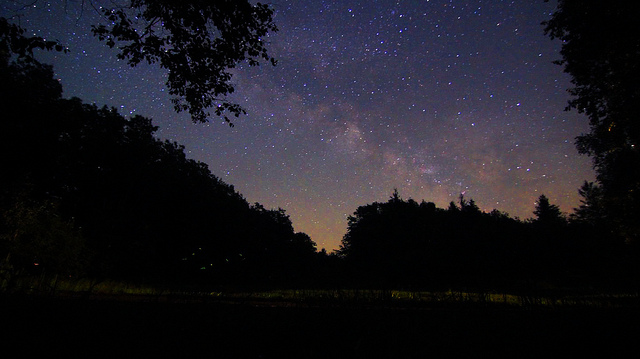
milky way[Image:eastendpro]

You will become aware of the patterns that form the constellations, and even though you may not know their names, you will see that amongst them twinkle many varied stars. The brighter ones can shine in several colours ranging from orangey red, through yellow, white and finally to blue. The blue stars are the hottest of all, with temperatures so high as to be meaningless to our minds.

With our dry air up in the Axarquía hillsides, we get a really clear view of all that the night sky can offer.

One of the most awe-inspiring sights is the Milky Way, the luminescent band of light, clearly visible in the Andalucían night sky.  The Milky Way spreads across the sky, passing through the constellation known as Cygnus (The Swan).  It is quite astonishing to realize when we look up at this broad band of hazy light, that what we are actually seeing is millions and millions of single stars, too far away to be identified individually.

Can you imagine staying at your villa in the beautiful countryside, East of Malaga, maybe floating on your back on an airbed in your swimming pool, looking up at all this wonderful display that nature offers to us?

Let me tell you, it is MAGIC!

There is yet another cosmic masterpiece available.  At certain times of the year our planet Earth passes through bands of dust and debris that circle the Sun.  We see these as meteor showers.  There are several occasions each year, but a good show is the Perseids meteor showers, around the 12th August.    Once again we shall be floating on our pool, watching these tiny fragments of space dust hurtling into our atmosphere at enormous speeds, 30 miles per second or more, and burning up to provide magnificent celestial fireworks.

Much slower are our own Earth-launched satellites which drift lazily by, so often these days, that you can usually spot one within a few minutes.  Their speed is deceptive though, because the satellites are very high, they actually have to maintain about 18,000 miles per hour to remain in orbit.

Do you have a favourite place where you can gaze at the natural wonders of the Earth?

Whilst you´re here, you might like to look at:

Photographs I love …. and why!

A Slice of Life: Garden and plant irrigation

We have a great climate here in Andalucía, east of Málaga, with warm, sunny days and little or no rain from May to September or even October.   So, how do our gardens and plants survive?

If you live in a town or village house with a small garden, or just a few pots,  you will easily be able to water your plants with a hose pipe or even a watering can, using the village water supply.

Before I go on, I should also explain that many plants such as established olive trees, almond trees, and various cactus and agaves etc. will continue to thrive without additional water.

The matter of irrigation really arises in larger gardens, especially in the countryside, and where trees and shrubs are fairly recently planted.


Depending on the shape and size of your land you will need quantities of black plastic, low-pressure, irrigation pipe, (the high pressure pipe is for a powerful mains supply only).   This pipe comes in long, coiled lengths of 200 or more metres. It is quite flexible and can be run out in lines or curves, up and down slopes of your land.

You will find it for sale in almost all towns and villages and a common useful diameter is 22 millimetres.

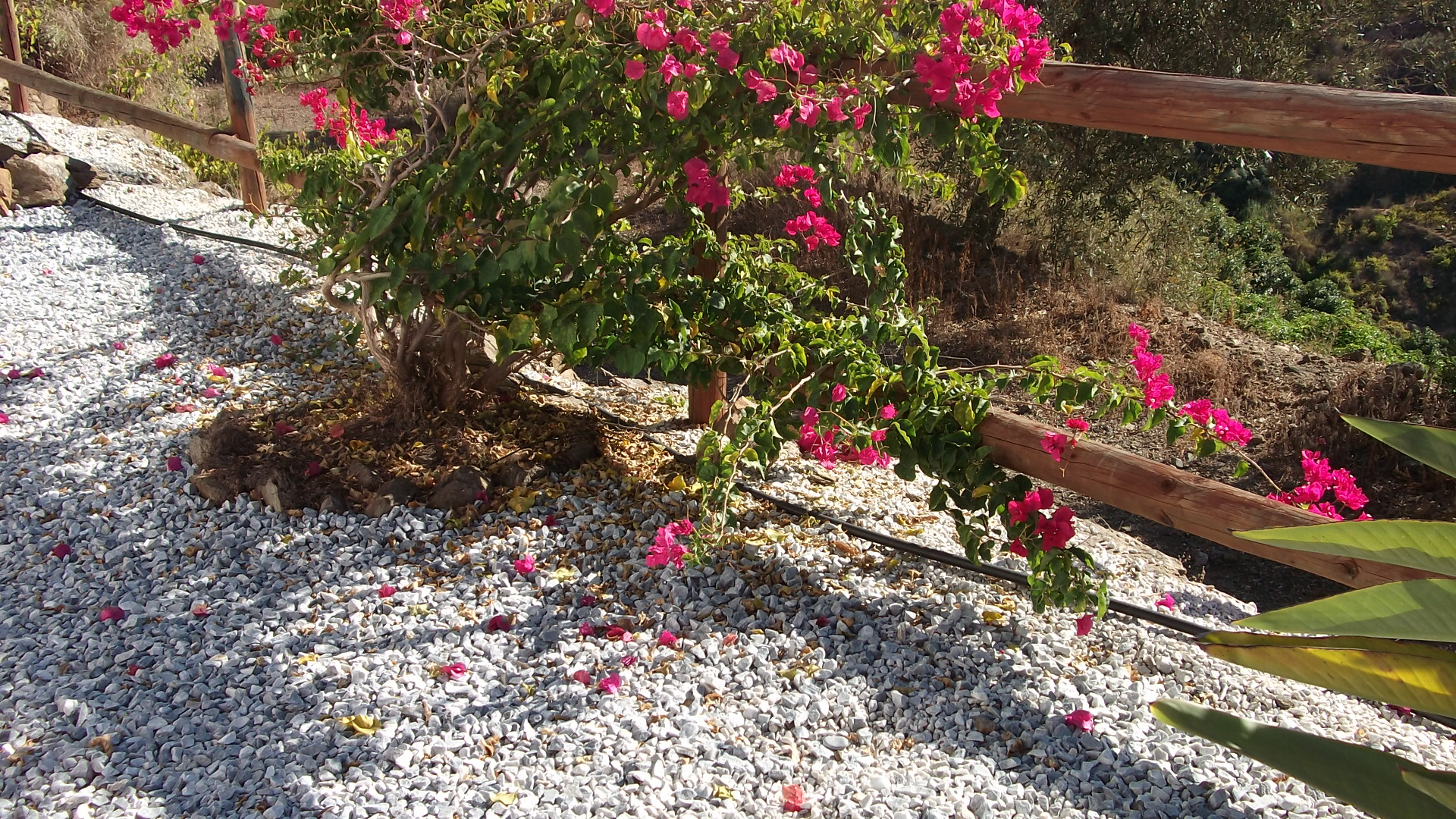
You will need to look at the layout of your garden and see how many different ways you need lengths of tubing to go, in order to take in all of your plants. It is unlikely that one single run of tubing will reach all the areas of your garden.  As you can see from the photo at the top of the page, it would be quite easy to hide the irrigation pipe under gravel, if you wish.

Wherever your outdoor water supply is, it is worth getting a plumber to fit several taps next to each other so that each irrigation pipe can be permanently attached and you will be able to operate each one in turn on irrigation day.

If it suits you better (or you are not a permanent resident) you can buy automatic timers to switch the water on and off, but we prefer the freedom to adapt the timing according to conditions.


You will also need to buy plastic end fittings for each length of pipe, together with some PTFE tape (favoured by plumbers) to make the joints watertight.

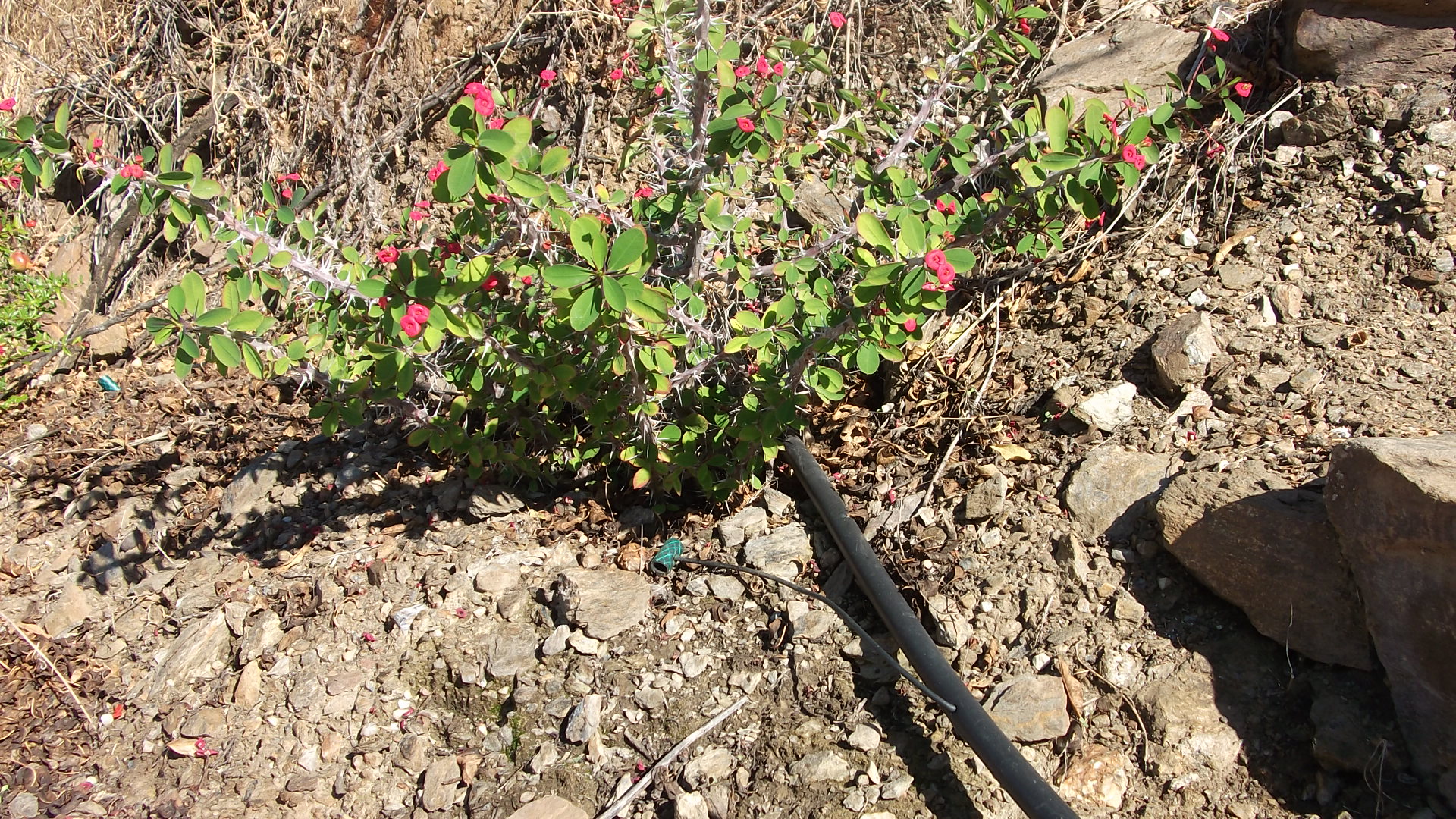
The other part of the system is the thin diameter ”spaghetti” tube which leads a small jet of water to each plant, together with a small hand tool, similar to a bradawl.  This tool will have a brass point on the end, the same diameter as the “spaghetti” tube and you simply poke it through the side wall of the 22mm irrigation pipe and insert a short piece of the thin tube, say about 30 cm to 60cm long.  Fortunately this is self sealing.

When you switch the water on, a small jet of water will squirt out of each piece of the “spaghetti” tube to water your plants.

Obviously you can have one or more of the “spaghetti” tubes for each plant – or more can be added later.  If you have two outlets for a plant, for example, you should have them inserted into the 22mm irrigation pipe about a metre apart and lead the outlets near to the newly planted tree roots.

Later as the plant grows and it’s roots spread out, you can move the spaghetti pipes further away from the tree or plant stem, to encourage the roots to continue to grow outwards.


How often to irrigate?  This is difficult to specify but try not to overdo it.  In high summer probably twice a week for 20-30 minutes, but after a year or two, once the plants are more established, the frequency can be reduced.  It’s best to give more water but less frequently, to prevent shallow rooting.  Always avoid giving little and often.

We usually irrigate our garden once the sun has gone down, which makes for less evaporation.

Hopefully, once the plants are established, winter irrigation shouldn’t be needed.

Happy gardening!