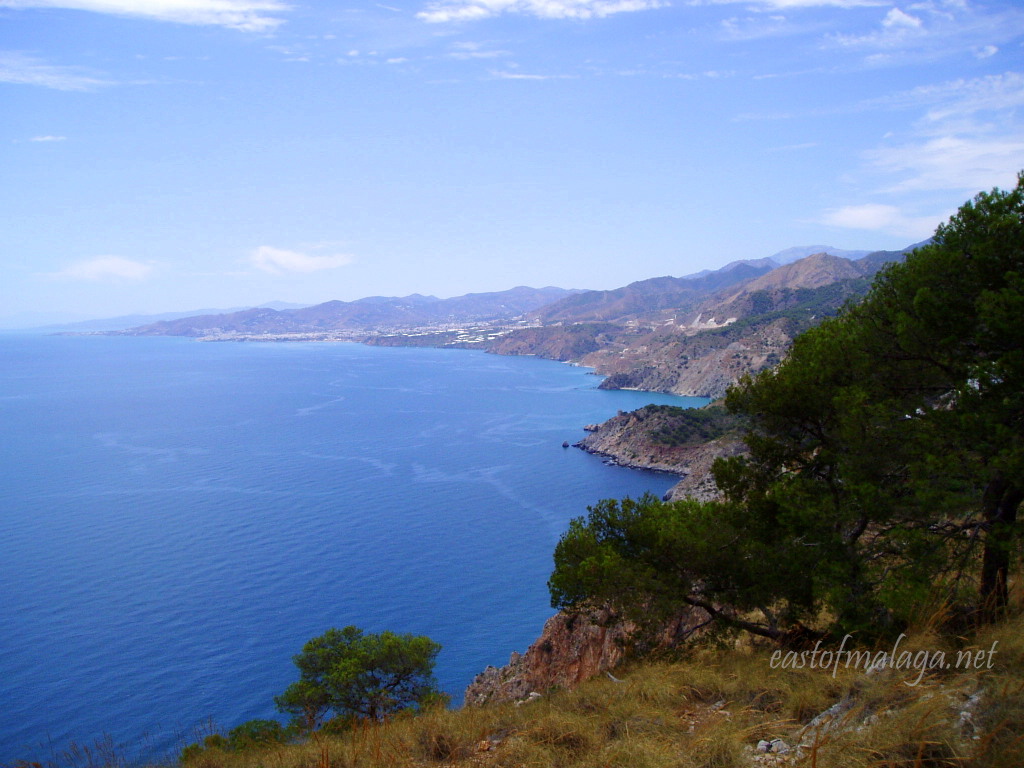
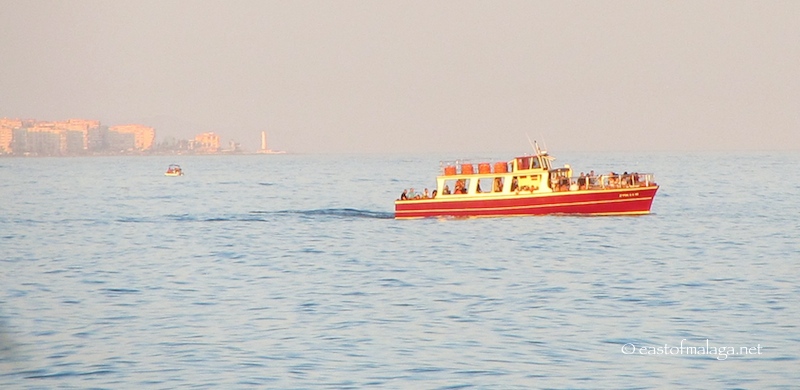
Looking along the coast, east of Málaga.
I receive a lot of messages from East of Málaga readers, either on the blog or over at my Facebook page. It seems that many folks think I know pretty much everything there is to know about Spain!! It’s absolutely not true, of course, but I have lived here in the Axarquía region, to the east of Málaga city for almost ten years, so I guess I do know a few things.
Anyway, one of the most common questions I get asked is about the Cost of Living in Spain, and in particular in Málaga province – and this is a subject I have written several articles about.
However, another frequently asked question is about where is the best place to rent or buy a house. This week I received the following message:
“We’re all booked for 10 day holiday to Cómpeta in October, viewing properties in Malaga, Torre del Mar and Cómpeta. So this week I’m searching the internet and organising viewings. My problem is we can’t decide where to buy – countryside, city or seaside! I was hoping for some guidance.”
It’s a valid question – so let’s see what I can do to help.
 As you might imagine, life can be very different, depending on your choice of location. Worth bearing in mind from the start is that almost all of the Axarquía region, and Andalucía in general, is mountainous with beautiful valleys running down from the inland sierras to the coastal fringe, giving plenty of opportunity to choose the landscape that best suits your needs.
Even though it’s an over-simplification, but let´s say, for the sake of argument that there are three main choices of area – the coastal zone (la costa), the inland villages (los pueblos) and the open countryside (known locally as “el campo”). Each has its devotees and all offer advantages.
In this series of articles entitled “Coast, Villages or Countryside” I will explore each in turn, to give you a flavour of what you can realistically expect in the various landscapes. Who knows, I might even get around to writing about what it’s like to live in the city of Málaga, too!
The Coast

First, let’s look at what is perhaps the most obvious choice for many, and particularly for first-time visitors, the coast. It would probably be more accurate to describe it as the coastal fringe, as many of the hills plunge right down to the sea with wider, flatter areas in between, where valleys run down to the coast.
In times gone by, most coastal villages and towns were fishing communities, given that the Mediterranean Sea provides a plentiful and varied supply of fish and sea food. Fortunately this tradition continues today, with a substantial fishing fleet at the port of Málaga as well as in nearby Caleta de Vélez, situated between Torre del Mar and Nerja.

As a result, all of the coastal areas have a large number of chiringuitos, which are beachside restaurants, often constructed right on the beach. Chiringuitos always offer a great range of fish and seafood on their menus, which would typically include fried pieces of cod (bacalao) in a lovely light batter, Dorada (gilt-head bream) cooked to perfection over a wood fire, as well as the local Málaga speciality of sardines (espetos de sardines). Don´t be put off by those dreadful tinned sardines they sell in Britain – these are the real deal – skewered on bamboo spikes and cooked next to a blazing wood fire. You might also like to try Rosada a la plancha, which is a succulent grilled fish, often flavoured with garlic. Absolutely delicious and one of my favourites!

Chiringuitos are also the place to try out the world-famous paella. Everyone knows of this flavoursome Spanish dish which, even though it originated in Valencia, is cooked to perfection all along the coast of the Axarquía. Even though most people will have heard of paella, dishes do vary from one place to another, some leaning towards chicken or pork as the base meat, but mostly on the coast you can expect plenty of fish, large prawns (gambas) and shellfish. I’ve never had one I didn’t like!
There are bars and cafés on nearly every corner in towns and villages, in fact all along the eastern Costa del Sol you will never be far from a bar. Fortunately, bars and cafés as well as tapas bars and chiringuitos, are largely interchangeable. It´s unusual to find people going into a bar merely to drink. Beer, wine, fino sherry or coffee are just one part of the combined eating and drinking culture, and luckily the Spanish and most long-term residents seem to have this well-balanced. It is rare to see things get out of hand.

A typical “snap-shot” view almost anywhere along this relaxed coastline is likely to be of the sparkling Mediterranean Sea, rarely more than gently rolling waves, sandy shores with plenty to do, sun beds for hire with the usual sun-shades in all the tourist areas, many wonderful places to eat freshly-prepared food of consistently high quality and a climate which is reputed to be the best in Europe.
Talking of climate, something that you might not have thought of when you are considering where to visit or live is that the temperature can differ by a few degrees from the coastal areas to some of the inland villages. This is not surprising really, given that some of the villages in Andalucía are situated more than 700 metres above sea level, but it might be an influencing factor to your decision about where to live or visit if you knew that a particular village was colder in the winter or hotter in the summer than the coast.

El Ingenio shopping centre, near Torre del Mar
No matter whether you spend your time at the coast or inland it is as well to know that the major supermarkets are usually situated along the coastal area. Both Spanish and German chains are represented, for example with Eroski, Mercadona and Supersol from Spain, as well as Aldi and Lidl from Germany, each one having their own appeal.
As well as supermarkets there is a larger range of shops near the coast than elsewhere and substantial indoor shopping centres are available on the outskirts of Torre del Mar and at Rincón de la Victoria, with cinemas and other entertainment options at each location. The Axarquía’s only Carrefour supermarket can be found at the shopping centre at Rincón de la Victoria.

Atarazanas market, Malaga
On the topic of shopping and extra facilities, you should not overlook the provincial capital city, Málaga, also on the coast. There is the recently refurbished city market, Mercado Central de Atarazanas, as well as large branches of the Spanish departmental store, El Corte Inglés. Naturally, the city is also home to a fantastic range of tapas bars, sporting facilities, art galleries and entertainment.
One thing you should be aware of is that although May to October is the main holiday season, the seaside in this part of the world can, and often does, provide really warm sunny days all year round – in fact, around 320 of them!. We enjoy lovely sunny days in January and February, although the weather is not quite as dependable around this time of year. A common feature during the winter months, not only on the coast but also inland, might be to have a couple of days with rain and some wind, after which the weather reverts to clear sunny days once again.

The main beach resorts east of Málaga are much more low-key than some on the western Costa del Sol, but make no mistake, they each have their charms, and are worthy of a visit, though they do still tend to get crowded in July and August.
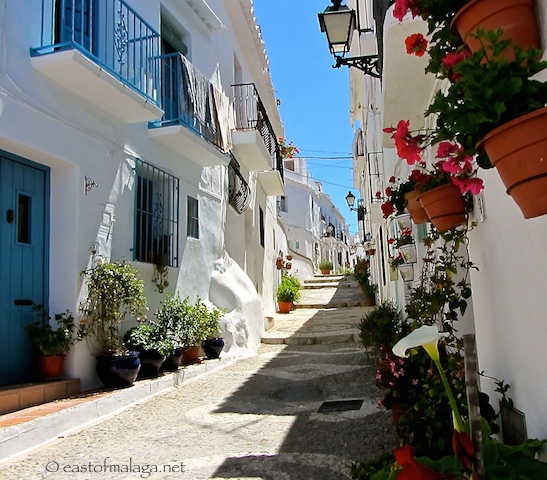
Have a look on a local map and you will see Rincón de la Victoria, Torre del Mar (which is very popular with Spanish tourists), and Torrox Costa, a lovely smaller town (very popular with Germans). Near to the easterly limit of Málaga province is the delightful town of Nerja, with few high-rise buildings, still retaining its quaint narrow streets in the centre, and popular with British holiday makers.

Balcon de Europa, Nerja
Fortunately, all the towns and villages along the coastal strip are easy to travel between, due to two excellent and largely uncongested roads running roughly parallel with each other – the N340 coastal road, and the wonderfully named Autovía del Mediterraneo, which is the motorway. Each of these roads connect the coastal region of the Axarquía direct to Málaga and the airport. If you don´t have a car available to you, there is a frequent (an inexpensive) bus service run by a company called ALSA, to get you back and forth if you choose.
Another thing to bear in mind about the coastal areas is that the land is flat. As I mentioned at the start of this article, the Axarquía is generally a mountainous area with beautiful valleys running down from the inland mountains to the coast. By the sea, there are lovely flat promenades and public gardens along many of the coastal towns and villages, which might be important to you if you have any problems with mobility.

Family holidays or a place to live, along a beautiful coastline, without rowdyism, with great facilities and fabulous food – East of Málaga is as good as it gets.
Next time I’ll look at the inland villages in more detail.






 East of Málaga